

What is TypeGraph?
TypeGraph is a TypeScript-first, embedded knowledge graph library that brings property graph semantics and ontological reasoning to applications using standard relational databases. Rather than introducing a separate graph database, TypeGraph lives inside your application as a library, storing graph data in your existing SQLite or PostgreSQL database.
Architecture
Section titled “Architecture”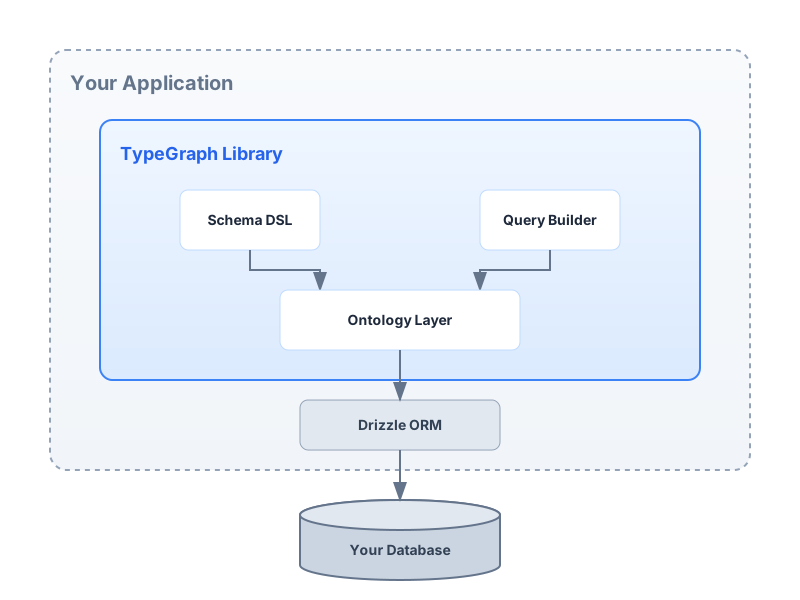
Core Capabilities
Section titled “Core Capabilities”1. Type-Driven Schema Definition
Section titled “1. Type-Driven Schema Definition”Zod schemas are the single source of truth. From one schema definition, TypeGraph derives:
- Runtime validation rules
- TypeScript types (inferred, not duplicated)
- Database storage requirements
- Query builder type constraints
const Person = defineNode("Person", { schema: z.object({ fullName: z.string().min(1), email: z.string().email().optional(), dateOfBirth: z.date().optional(), }),});2. Semantic Layer with Ontological Reasoning
Section titled “2. Semantic Layer with Ontological Reasoning”Type-level relationships enable sophisticated inference:
| Relationship | Meaning | Use Case |
|---|---|---|
subClassOf |
Instance inheritance (Podcast IS-A Media) | Query expansion |
broader |
Hierarchical concept (ML broader than DL) | Topic navigation |
equivalentTo |
Same concept, different name | Cross-system mapping |
disjointWith |
Cannot be both (Person ≠ Organization) | Constraint validation |
implies |
Edge entailment (marriedTo implies knows) | Relationship inference |
inverseOf |
Edge pairs (manages/managedBy) | Bidirectional queries |
3. Self-Describing Schema (Homoiconic)
Section titled “3. Self-Describing Schema (Homoiconic)”The schema and ontology are stored in the database as data, enabling:
- Runtime schema introspection
- Versioned schema history
- Self-describing exports and backups
- Migration tooling
4. Type-Safe Query Compilation
Section titled “4. Type-Safe Query Compilation”Queries compile to an AST before targeting SQL:
- Consistent semantics across SQLite and PostgreSQL
- Type-checked at compile time
- Query results have inferred types
5. Temporal and Bitemporal History
Section titled “5. Temporal and Bitemporal History”Every node and edge has a valid-time window (validFrom / validTo), so you
can ask what was true at a domain instant with .temporal("asOf", T) or
store.asOf(T). Stores created with { history: true } also capture recorded
time for TypeGraph-managed writes, the system-time axis that remembers when the
graph wrote each fact down. store.asOfRecorded(T) reconstructs what the graph
captured at a recorded instant, and
store.asOf(validT).asOfRecorded(recordedT) pins both axes independently.
Use it for audit trails, agent decision replay, effective-dated policies, and breach forensics. See Temporal queries and the Bitemporal Time Travel example.
Design Philosophy
Section titled “Design Philosophy”Embedded, Not External
Section titled “Embedded, Not External”TypeGraph is a library dependency, not a networked service. TypeGraph initializes with your application, uses your database connection, and requires no separate deployment.
Schema-First, Type-Driven
Section titled “Schema-First, Type-Driven”Define your schemas once with Zod, and TypeGraph handles validation, type inference, and storage. No duplicate type definitions or manual synchronization.
Explicit Over Implicit
Section titled “Explicit Over Implicit”TypeGraph favors explicit declarations:
- Relationships are declared, not inferred from foreign keys
- Semantic relationships are explicit in the ontology
- Cascade behavior is configured, not assumed
Portable Abstractions
Section titled “Portable Abstractions”The query builder generates portable ASTs that can target different SQL dialects. The same query code works with SQLite and PostgreSQL.
What TypeGraph Is Not
Section titled “What TypeGraph Is Not”TypeGraph deliberately excludes:
- Broad graph analytics suites: Focused PageRank, connectivity, and deterministic label-propagation primitives are built in; modularity optimization and most centrality measures are not
- Distributed storage: Single-database deployment only
These exclusions keep TypeGraph focused and maintainable.
Note: TypeGraph does support semantic search via native database vector engines: pgvector for PostgreSQL, sqlite-vec for the local (better-sqlite3) SQLite backend, and libSQL’s built-in vectors for the libSQL / Turso backend. See Semantic Search for details.
Note: TypeGraph does support fulltext search — native BM25 on SQLite (FTS5)
and tsvector + GIN on PostgreSQL, with a query-builder
n.$fulltext.matches() predicate that composes with any other predicate.
Combine with semantic search for hybrid RAG retrieval. See
Fulltext Search for details.
Note: TypeGraph does support variable-length paths via .recursive() with
configurable depth limits, optional path/depth projection, and explicit cycle
policy. Cycle prevention is the default.
See Recursive Traversals for details.
Note: TypeGraph ships Tier 1 graph algorithms (shortest path, reachability,
neighborhoods, and degree) on store.algorithms.*. Traversal calls use a
set-based BFS frontier, while degree uses a single count query. See
Graph Algorithms for details.
Note: TypeGraph supports runtime schema induction via graph
extensions. An LLM or ingestion agent can propose a typed schema as a
JSON-serializable document, an operator approves it, and store.evolve()
atomically commits a new schema version — no redeploy, full Zod
validation, restart parity. See Graph Extensions
for the agent-driven workflow.
Note: TypeGraph ships graph merge — fork a store into isolated working
copies, let many writers (parallel agents, importers, reviewers) edit
independently, then reconcile them into one canonical graph with deterministic
entity resolution (exact / blocking / fulltext / vector / hybrid), edge
repointing, conflict reporting, and provenance. mergeIncremental() folds new
sources into a live graph without creating duplicates — the primitive for
multi-agent knowledge-graph construction and continuous ingestion. See
Graph Merge for the full guide.
Note: TypeGraph supports bitemporal graph reads. Valid time answers “when was this fact true in the domain?” Recorded time answers “when did the graph record it?” Together they reconstruct prior captured state after corrections, replay agent decisions against the graph they actually saw, and traverse access graphs at a breach instant for TypeGraph-managed writes. See Temporal queries and the Agent Decision Replay example.
Why TypeGraph?
Section titled “Why TypeGraph?”Compared to Graph Databases (Neo4j, Amazon Neptune)
Section titled “Compared to Graph Databases (Neo4j, Amazon Neptune)”Graph databases are powerful but come with operational overhead:
| Aspect | Graph Database | TypeGraph |
|---|---|---|
| Deployment | Separate service to manage, scale, and monitor | Library in your app, uses existing database |
| Network | Additional latency for every query | In-process, no network hop |
| Transactions | Separate transaction scope from your SQL data | Same ACID transaction as your other data |
| Learning curve | New query language (Cypher, Gremlin) | TypeScript you already know |
| Graph algorithms | Broad suites (PageRank, shortest path, community detection) | Focused algorithms (shortest path, reachability, neighborhoods, degree, WCC, label propagation, PageRank/PPR) |
| Scale | Optimized for billions of nodes | Best for thousands to millions |
Choose TypeGraph when your graph is part of your application domain (knowledge bases, org charts, content relationships) rather than a standalone analytical system.
Compared to ORMs (Prisma, Drizzle, TypeORM)
Section titled “Compared to ORMs (Prisma, Drizzle, TypeORM)”ORMs model relations through foreign keys, which works well for simple associations but lacks graph semantics:
| Aspect | Traditional ORM | TypeGraph |
|---|---|---|
| Relationships | Foreign keys, eager/lazy loading | First-class edges with properties |
| Traversals | Manual joins or N+1 queries | Fluent traversal API, compiled to efficient SQL |
| Inheritance | Table-per-class or single-table | Semantic subClassOf with query expansion |
| Constraints | Foreign key constraints | Disjointness, cardinality, implications |
| Schema | Migrations alter tables | Schema versioning, JSON properties |
Choose TypeGraph when you need to traverse relationships, model type hierarchies, or enforce semantic constraints beyond what foreign keys provide.
Compared to Triple Stores (RDF, SPARQL)
Section titled “Compared to Triple Stores (RDF, SPARQL)”Triple stores and RDF provide rich ontological modeling but have practical challenges:
| Aspect | Triple Store | TypeGraph |
|---|---|---|
| Type safety | Runtime validation, stringly-typed | Full TypeScript inference |
| Query language | SPARQL (powerful but verbose) | TypeScript fluent API |
| Schema | OWL/RDFS (complex specification) | Zod schemas (familiar, composable) |
| Integration | Separate system, data sync required | Embedded in your app |
| Inference | Full reasoning engines available | Precomputed closures, practical subset |
Choose TypeGraph when you want ontological concepts (subclass, disjoint, implies) without the complexity of full semantic web stack.
The TypeGraph Sweet Spot
Section titled “The TypeGraph Sweet Spot”TypeGraph is designed for applications where:
- The graph is your domain model — not a separate analytical system
- You already use SQL — and don’t want another database to manage
- Type safety matters — you want compile-time checking, not runtime surprises
- Semantic relationships help — inheritance, implications, constraints add value
- Scale is moderate — thousands to millions of nodes, not billions
When to Use TypeGraph
Section titled “When to Use TypeGraph”TypeGraph is ideal for:
- Knowledge bases with typed entities and relationships
- Organizational structures with hierarchies and roles
- Content graphs with topics, articles, and references
- Domain models requiring semantic constraints
- RAG applications combining graph traversal with vector search
- Multi-source ingestion & entity resolution — reconcile parallel agent or importer outputs into one canonical graph with graph merge
- Auditable AI systems and forensics — reconstruct the graph an agent or investigator saw at a recorded instant with bitemporal reads
TypeGraph is not ideal for:
- Large-scale graph analytics requiring distributed processing
- Social networks with billions of edges
- Real-time streaming graph data
- Applications requiring a broad graph-data-science suite such as community
detection or betweenness centrality (use Neo4j or a graph library; focused
algorithms—including PageRank and weighted shortest path—ship on
store.algorithms.*)