

TypeGraph vs. Neo4j, LadybugDB and pgGraph: Who Wins What
My first pass at benchmarking TypeGraph against real graph databases ran the seven LDBC “short read” queries (IS1–IS7) against Neo4j and LadybugDB. TypeGraph on SQLite won every one of them, which should have made me suspicious rather than happy: IS1–IS7 are point lookups and one-hop walks, and an in-process engine doing direct index seeks can’t lose that race to anything that pays a network round trip.
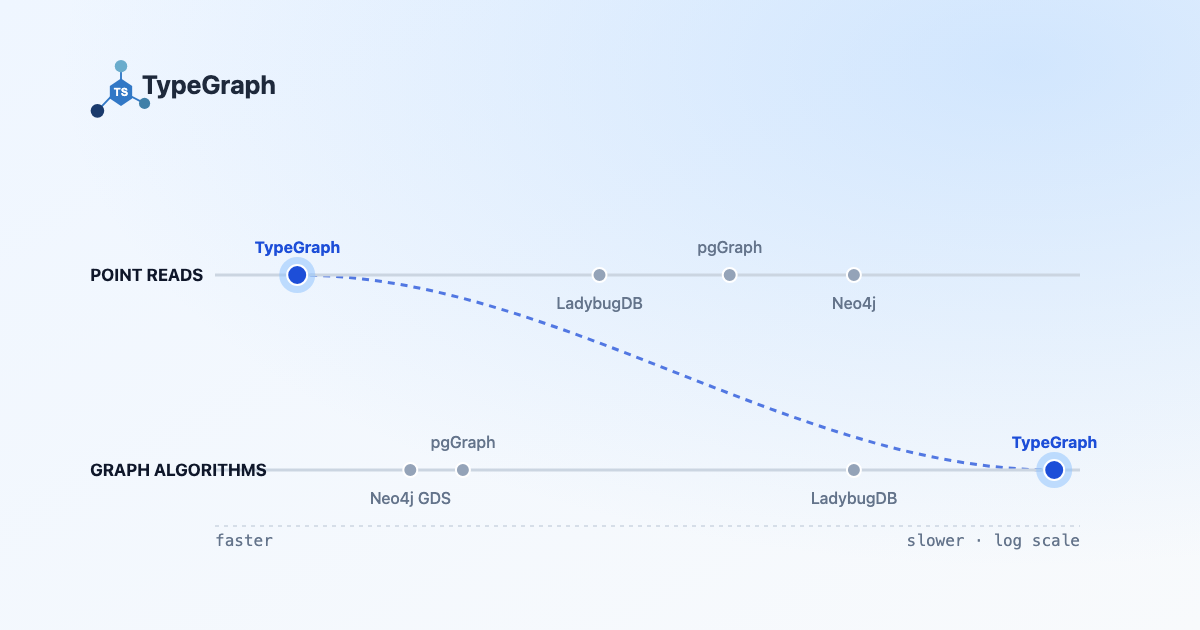
So I rebuilt the harness around the queries a graph database is supposed to win (shortest paths, bounded neighborhood walks, complex multi-hop reads, and whole-graph algorithms) and ran 17 queries against five engines at two scales. The short version:
- TypeGraph on SQLite still wins every point read, usually by 10–100x.
- The engines that keep an in-memory graph index win whole-graph algorithms by three to four orders of magnitude, and the gap gets wider as the data grows.
I’m publishing both results rather than only the flattering one.
The setup
Section titled “The setup”All five engines run through one shared harness
(packages/benchmarks/src/real/):
| Engine | Version |
|---|---|
| SQLite | 3.53.2 (via better-sqlite3 12.11.1) |
| PostgreSQL (TypeGraph backend) | 18.1 (pgvector/pgvector:pg18 image) |
| Neo4j | neo4j:2026.05.0 server image, neo4j-driver 6.2.0, GDS plugin |
| LadybugDB | @ladybugdb/core 0.18.0 |
| pgGraph | Evokoa pgGraph 0.1.8 (ghcr.io/evokoa/pggraph:0.1.8, bundles PostgreSQL 17) |
pgGraph is the new entrant, and I think it’s clever. Rather than being a separate database, it’s a Postgres extension that builds a derived CSR (compressed sparse row) index over ordinary normalized tables and exposes traversal and pathfinding as SQL functions. Its point reads are tuned Postgres, and the CSR index only comes into play once a query traverses.
The 17 queries are the original IS1–IS7; IC13 (shortest path) and IC14 (weighted shortest path); BFS3, a bounded neighborhood walk; three complex reads (IC2, IC8, IC9); and four graph-algorithm queries: GA_DEGREE, GA_WCC (weakly connected components), and GA_BFS / GA_SSSP (whole-component reachability and shortest-path depth from a seed).
I held the comparison to two rules. Every result is checked with a
value-level digest, per row, across every engine that runs the query, and
every run below passed, since a fast wrong answer shouldn’t count. And nothing
is skipped silently: an engine without a comparable primitive for a query
reports a typed gap, so a gap cell means the engine can’t run that query
in a comparable form, not that I didn’t get around to it.
Scales are SF1 (9,892 persons, 361K directed knows edges) and SF10
(65,645 persons, 3.88M knows, 21.9M comments). Each is one run on an EC2
host with shared vCPUs, so treat sub-millisecond cells and anything flagged
noisy as order-of-magnitude.
p50 latency in milliseconds unless noted. Fastest engine per row in bold.
| Query | typegraph-sqlite | typegraph-postgres | neo4j | ladybugdb | pggraph |
|---|---|---|---|---|---|
| IS1 | 0.03 | 0.76 | 4.84 | 1.11 | 0.93 |
| IS2 | 1.85 | 21.5 | 39.9 | 76.0 | 19.9 |
| IS3 | 0.24 | 1.82 | 4.07 | 4.5 | 1.47 |
| IS4 | 0.02 | 0.98 | 3.01 | 0.39 | 0.91 |
| IS5 | 0.03 | 1.08 | 3.1 | 1.61 | 0.94 |
| IS6 | 0.07 | 1.97 | 3.23 | 3.93 | 1.89 |
| IS7 | 0.07 | 2.15 | 5.74 | 7.83 | 1.76 |
| IC13 (shortest path) | 3.88 | 22.3 | 3.24 | 9.91 | 2.18 |
| IC14 (weighted SP) | 5586 | 4860 | gap | gap | gap |
| BFS3 | 220 | 1139 | 468 | 1539 | 357 |
| IC2 | 51.8 | 523 | 36.2 | 89.1 | 347 |
| IC8 | 3.06 | 17.3 | 3.73 | 24.2 | 8 |
| IC9 | 2236 | 15069 | 3388 | 775 | 3498 |
| GA_DEGREE | 0.03 | 1.09 | 2.97 | 1.8 | 0.72 |
| GA_WCC | 7269 | 24237 | 18.7 | gap | 9.53 |
| GA_BFS | 221 | 1828 | 24.5 | gap | 288 |
| GA_SSSP | 220 | 1742 | 23.6 | gap | 284 |
Point reads
Section titled “Point reads”TypeGraph on SQLite takes every IS row, often by one to two orders of magnitude, because it’s the only engine here that pays no network round trip and no per-call query planning overhead. GA_DEGREE and IC8 go the same way, because underneath the “algorithm” and “complex read” labels they’re point lookups too.
This is the case for an embedded graph. Most of what an application asks its graph all day looks like IS1–IS7 (fetch this person, their recent posts, who they know), and on IS1 Neo4j takes 4.84ms where SQLite takes 0.03ms.
Graph algorithms
Section titled “Graph algorithms”GA_WCC, GA_BFS, GA_SSSP, and IC13 are what a graph engine’s specialized index exists for, and here the CSR engines are in a different league:
- pgGraph wins GA_WCC (9.53ms) and IC13 (2.18ms), running union-find and shortest path directly over its CSR index.
- Neo4j with the GDS plugin wins GA_BFS (24.5ms) and GA_SSSP (23.6ms). Without GDS, Neo4j answers these with Cypher path enumeration, which works but is slow. With GDS it projects the graph into memory once and runs the same kind of set-based traversal pgGraph does.
- TypeGraph is three to four orders of magnitude slower on GA_WCC (7,269ms on SQLite, 24,237ms on Postgres, against pgGraph’s 9.53ms).
That last gap isn’t a bug I can fix. TypeGraph’s algorithms run as rounds of SQL, one window or aggregate query per round, however well indexed, while pgGraph and GDS hold the graph in an in-memory structure built for this access pattern, and query tuning won’t make SQL iteration behave like a CSR traversal.
The SF10 run happened before I added the GDS plugin to the Neo4j setup, so
Neo4j’s graph-algorithm rows show gap here even though Neo4j can run them.
For Neo4j on those queries, the SF1 table above is the current picture.
s = seconds; otherwise milliseconds.
| Query | typegraph-sqlite | typegraph-postgres | neo4j | ladybugdb | pggraph |
|---|---|---|---|---|---|
| IS1 | 0.03 | 1.06 | 5.22 | 1.12 | 0.93 |
| IS2 | 2.35 | 77.2 | 133 | 104 | 22.6 |
| IS3 | 0.42 | 6.23 | 53.8 | 15.7 | 1.87 |
| IS4 | 0.03 | 0.91 | 3.33 | 0.90 | 0.96 |
| IS5 | 0.04 | 8.67 | 5.52 | 2.68 | 0.96 |
| IS6 | 0.07 | 3.69 | 8.09 | 5.50 | 2.02 |
| IS7 | 0.07 | 7.29 | 8.23 | 8.38 | 1.80 |
| IC13 (shortest path) | 35.0 | 339 | 82.2 | 161 | 2.25 |
| IC14 (weighted SP) | 74.6s | 57.3s | gap | gap | gap |
| BFS3 | 1.7s | 7.2s | 3.9s | 9.3s | 2.2s |
| IC2 | 141 | 724 | 138 | 296 | 843 |
| IC8 | 5.24 | 220 | 92.1 | 47.6 | 15.3 |
| IC9 | 11.9s | 76.7s | 15.5s | 3.1s | 25.4s |
| GA_DEGREE | 0.06 | 1.05 | 3.02 | 2.07 | 0.82 |
| GA_WCC | 119.9s | 506.0s | gap | gap | 69.0 |
| GA_BFS | 2.8s | 22.3s | gap | gap | 2.0s |
| GA_SSSP | 2.8s | 22.3s | gap | gap | 1.9s |
Point reads barely move at 10x the data, as you’d expect from an indexed seek. The more interesting number is how GA_WCC grows:
| Engine | SF1 | SF10 | Growth |
|---|---|---|---|
| pggraph | 9.53ms | 69.0ms | ~7x |
| typegraph-sqlite | 7269ms | 119.9s | ~16x |
| typegraph-postgres | 24237ms | 506.0s | ~21x |
pgGraph grows a bit less than linearly with the data, while TypeGraph’s round-by-round algorithm grows faster than linearly because more edges also means more rounds, so the gap gets bigger as the data grows. If you need whole-graph analytics over millions of edges on a schedule, use a specialized engine for that job.
SQLite beats Postgres, even inside TypeGraph
Section titled “SQLite beats Postgres, even inside TypeGraph”Both TypeGraph backends run the same logical algorithms, and SQLite is 4–8x
faster on the heavy ones at SF10 (GA_WCC 119.9s vs 506.0s, GA_BFS 2.8s vs
22.3s, IC9 11.9s vs 76.7s). My first guess was network round trips, but that
doesn’t hold up: GA_BFS already issues one INSERT ... RETURNING per round,
Postgres is on loopback, and the ratio stays about 8x at both scales, whereas
a fixed per-call cost would shrink as a share of a longer run. That points at
a per-row cost in how Postgres executes these queries, which I haven’t tracked
down yet.
The one exception is IC14, the weighted shortest path, where Postgres wins. Its set-based frontier expansion handles a large, unbounded Dijkstra better than SQLite’s row-at-a-time version.
IC14: the one only TypeGraph ran
Section titled “IC14: the one only TypeGraph ran”IC14 asks for the lowest-cost path between two people rather than the fewest
hops. In this lineup, nothing else could run it in a comparable form:
Neo4j’s GDS has no stored knows weight to project, pgGraph’s shortest path
counts hops only, and LadybugDB’s weighted shortest path isn’t wired into the
harness yet. TypeGraph answers it on both backends with
store.algorithms.weightedShortestPath, at real LDBC scale (5.6s / 4.9s at
SF1, 75s / 57s at SF10), with byte-identical results across the two.
Those times aren’t fast, and the benchmark makes them look worse than real use would, because it picks random pairs near the graph’s diameter, which is the worst case for single-source Dijkstra. Real weighted-path questions tend to be between related, nearby entities, where the same algorithm stops early.
Loading
Section titled “Loading”Loading is where TypeGraph still trails. It improved a lot between my first run and this one, because in the meantime 0.37 shipped a trusted initial import, and the benchmark loader now uses it.
importGraph validates every row it writes: schema shape, edge endpoints,
cardinality, conflicts. That’s the right default, since most imports come
from somewhere you don’t fully trust. But when you’re filling a brand-new
database from an export you produced and already validated, every one of
those checks is wasted work. trustedImportGraph and
trustedImportGraphStream skip them. They bypass the normal write pipeline,
drop secondary indexes, insert straight into the tables, then rebuild the
indexes and refresh statistics, all in one transaction.
Loading the same 200,000 nodes and 200,000 edges into a fresh SQLite database both ways:
run 1 — importGraph: 6783ms trustedImportGraphStream: 2455msrun 2 — importGraph: 7253ms trustedImportGraphStream: 2206msrun 3 — importGraph: 5048ms trustedImportGraphStream: 2116msTrusted import was 2.5–3x faster on every run. The streaming form takes a header, then node chunks, then edge chunks, so the loader here reads the LDBC CSVs in two bounded passes instead of holding a multi-million-row graph in memory.
Skipping validation needs a narrow contract. The node and edge tables must
be completely empty, and TypeGraph only checks stream order and kind names.
Property shapes, endpoints, and duplicate-free IDs are on you. Features whose
extra writes it would otherwise skip (history, uniqueness constraints,
searchable() and embedding() fields) are rejected outright. Point it at
a database with rows in it and it throws before touching anything:
TrustedImportError: Trusted import requires globally empty TypeGraph node and edge tables. details: { tables: ["typegraph_nodes", "typegraph_edges"], reason: "database_not_empty" }For anything that isn’t a one-time load of a fresh, dedicated database, use
importGraph (untrusted data, conflicts, history, search fields) or
collection bulkInsert (trusted data going into a database that isn’t
empty).
Here’s what it did to the benchmark:
| Engine | SF1 load | Earlier run | SF10 load |
|---|---|---|---|
| ladybugdb | 46s | 41.6s | 373s |
| neo4j | 66s | 71.4s | 409s |
| pggraph | 120s | — | 1,119s |
| typegraph-sqlite | 164s | 587.1s | 2,199s |
| typegraph-postgres | 344s | 669.3s | 3,278s |
TypeGraph on SQLite went from 587s to 164s (~3.6x) and on Postgres from 669s
to 344s (~1.9x). SQLite is now within about 1.4x of pgGraph, while
Postgres is still about 3x slower than pgGraph at both scales, because pgGraph
loads through batched INSERTs tuned for its own schema and TypeGraph’s
Postgres path still uses prepared statements instead of COPY. Switching to
COPY is next, and unlike most of what this benchmark turned up, it would
help every Postgres user.
pgGraph as an accelerator
Section titled “pgGraph as an accelerator”pgGraph is the most interesting result here, less for the rows it wins than for how it works. It indexes tables that already look a lot like the ones TypeGraph’s Postgres backend writes (normalized nodes and edges in Postgres, queryable over the same connection), which is why its point reads look like tuned Postgres while its traversal numbers look like a graph engine’s.
None of this is built yet. The pgGraph driver in this benchmark loads its own copy of the data into its own schema. It doesn’t sit on top of a TypeGraph-managed database. But the numbers suggest the shape of a pairing: use TypeGraph for the point reads and everyday writes it already wins, and when profiling finds a real whole-graph workload (components, centrality, unweighted shortest path at scale), build a pgGraph index over the same tables and send just that query through it. I’m excited about that direction, because it keeps everything in one database without giving up anything on the queries applications run most.
What the slow rows actually mean
Section titled “What the slow rows actually mean”It’s tempting to read every slow cell as a TypeGraph bug. Mostly they aren’t:
- IC9 is a modeling artifact. LDBC models a message’s creator as an edge,
so ranking a feed means fetching a sort key for every candidate first: 1.2M
of them at SF1 to return the top 20. A real feed would put the owner on the
item and index
(owner, created_at), whichdefineNodeIndexalready supports, so the fix belongs in the schema rather than the engine. - The whole-graph algorithms are architectural. Tuning has helped (a delta-frontier rewrite of connected components nearly halved the Postgres GA_WCC time during this work), but it won’t close a 1,000x gap. Pairing with something like pgGraph for those queries is the realistic answer.
- IC14 is benchmark-amplified, as above.
And the caveats: one run per scale on a shared-vCPU host, so several cells are noisy and should be read as order-of-magnitude. What I’m confident in regardless: every query passes value-level parity across every engine that runs it, and the direction of every finding is far larger than run-to-run noise.
Try it
Section titled “Try it”- The harness: all five engine drivers and the EC2 runner
- Full results and investigation notes:
sf1-results.md,sf10-results.md - Trusted initial import: the full contract
- TypeGraph 0.35: Faster Almost Everywhere: the fixes an earlier run of this benchmark turned up
Stay in the loop
Occasional updates on new features, guides, and releases. No spam.