

One Round Trip Per Write
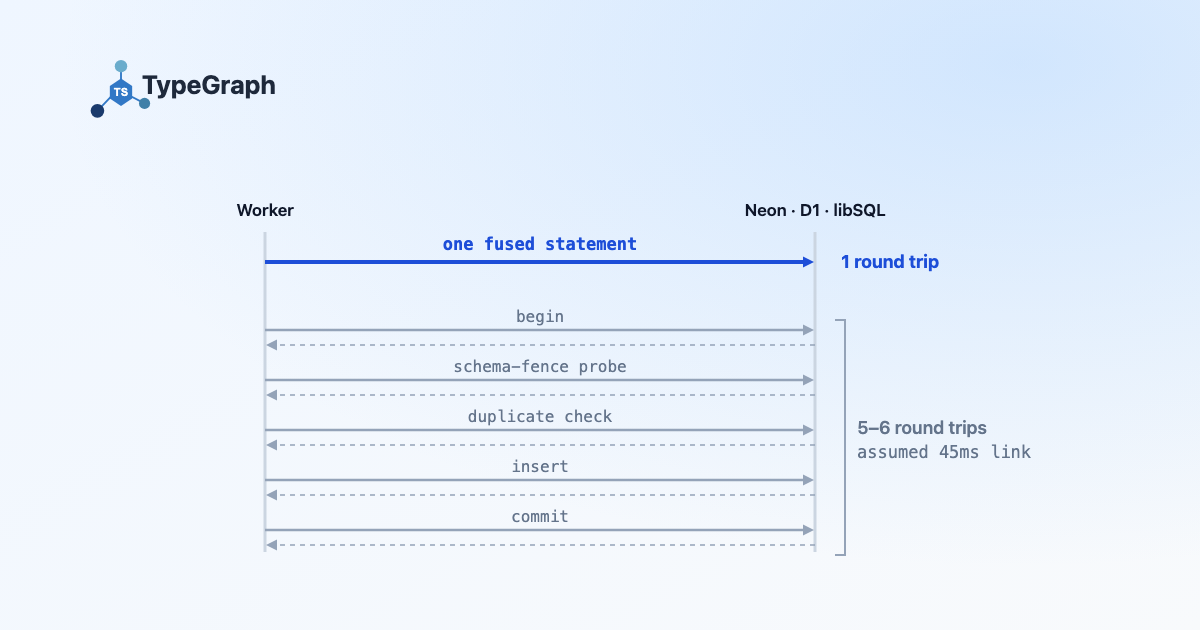
I turned on statement logging, turned off prepared statements, and created one node. This is what went over the wire:
beginSELECT ... schema-version fence probeSELECT ... duplicate/endpoint checkINSERT ... (the write)commitThat’s five round trips to write one row. On a pooled connection sitting next to the database you’d never notice, but a lot of people run TypeGraph from edge functions against managed Postgres, where a round trip is more like 45ms and each of those statements pays it in full, so the row takes roughly a quarter of a second to exist.
When I captured a first-run provisioning flow for one graph, it issued 97
statements, and about 40 of them, spread across just seven writes, were
schema-version probes, duplicate checks, and begin/commit rather than
actual writes.
That was issue #533, and closing it took two releases. The short version: an eligible write and every check it depends on now go to the database together, as one request.
A note on the numbers: everything below is a count of requests crossing the transport, which is what I measured. Latency figures are that count times an assumed 45ms round trip, not wall-clock benchmarks.
Checks and write, in one statement
Section titled “Checks and write, in one statement”The old path was a sequence of reads, each deciding whether the write could proceed: whether the schema version still matched, whether the row was a duplicate, whether the edge’s endpoints existed, and whether the cardinality constraint held. Each of those was another round trip, and the whole sequence was wrapped in a transaction so nothing could change between the checks and the insert.
In 0.52, for the common shape on Postgres (schema-managed, generated ID, no history or identity tracking), all of those checks and the insert compile into a single statement, and the database evaluates the conditions and performs the write atomically.
That takes five or six sequential requests down to one, which at 45ms removes roughly 180–225ms of waiting from every such write. On Neon’s WebSocket driver, a typical get-or-create that misses drops from five requests to one.
When a write needs something a single statement can’t carry (history capture,
a caller-owned transaction, call-level matchOn), it takes the ordinary
transactional path, which is still there underneath for everything the fast
path doesn’t cover.
Batches on drivers without transactions
Section titled “Batches on drivers without transactions”The bigger win is on Neon HTTP, Cloudflare D1, and libSQL, which don’t give you an interactive transaction at all, only one-shot atomic batches. Before 0.52, a bulk write on one of them ran statement by statement, so it was slow and a partial failure left partial data behind.
Now TypeGraph compiles eligible bulk writes into a precompiled program that
those drivers execute as a single atomic batch. nodes.bulkInsert() becomes
one request, edge batches validate their endpoints inside the write instead of
reading candidate endpoints first, and batches with a cardinality constraint
(one, unique, oneActive) carry the constraint checks in the same batch.
Counting actual execute() / batch() calls on libSQL:
| Bulk edge write | Before | After |
|---|---|---|
| Unconstrained | 1 | 1 |
| With a durable match identity | 6 | 1 |
| With a cardinality constraint | 8 | 1 |
Since it’s all one batch, a conflict anywhere rolls the whole thing back. I wanted proof that the conflict check actually did something, so I wrote its regression test by deleting the conflict clause, watching duplicates land, and then putting the clause back and watching the same input get rejected.
0.53: the writes that have to look first
Section titled “0.53: the writes that have to look first”0.52 fused the writes that create things, which left the ones that need to know what’s already there: updates, upserts, and deletes that have to release the uniqueness claims their row held. 0.53 moved those onto the same programs.
- Single-row
update()anddelete()are one read plus one guarded write, rather than a transaction around both: 60–67% fewer requests. bulkUpsertById()is two requests: one batched read, one atomic write.bulkReplaceById()is new. Each item is a complete document, so there’s nothing to read first. Creates, replacements, resurrections of deleted rows, uniqueness claims, and fulltext and vector index updates all go in one request.- Large D1 upserts stay atomic. D1 allows 100 bind parameters per statement, so the program splits into many statements inside one atomic batch. That raised the ceiling from 17 nodes and 6 edges to 512 nodes and 187 edges per call. Anything bigger falls back to the regular path instead of building an unbounded request.
- Postgres transaction sessions run the same programs through a savepoint, so a rejected program doesn’t poison the transaction around it.
There’s one trade-off to know about: the fused update() is optimistic. It
doesn’t hold a lock between its read and its write, so if the row moved
underneath it, it re-reads and tries again, up to four times, and then throws
DatabaseOperationError. Under sustained contention on the same row, that can
fail a write that a transaction-capable backend used to serialize for you. I
think that’s the right trade for most workloads, but not for something like a
hot counter.
Letting the database decide: match identities
Section titled “Letting the database decide: match identities”Fusing an edge get-or-create needed something the database could arbitrate on its own, without a lock or an in-process cache: a real unique constraint. So 0.52 also added durable edge match identities. An edge can declare a named set of fields that identify it:
const worksAt = defineEdge("worksAt", {  schema: z.object({ role: z.string() }),});
edges: {  worksAt: {    type: worksAt,    from: [Person],    to: [Company],    cardinality: "many",    matchIdentity: { name: "employment", fields: ["role"] },  },},
TypeGraph stores that key on every edge row and backs it with a unique
index, on both SQLite and Postgres. Once that exists,
getOrCreateByEndpoints no longer has to read, decide, write, and hope
nothing raced, because it’s a single conditional insert the database resolves
atomically, which is what makes the one-request path safe on a stateless edge
worker with nothing in memory to lean on.
Changing a match identity is a breaking schema change and is rejected while
the edge kind has rows. Call-level matchOn still works for matching you
don’t want in the schema, through the regular transactional path.
Upgrading
Section titled “Upgrading”If you use a bundled backend (createLocalSqliteBackend,
createPostgresBackend, or one of the serverless factories), you don’t need to
change any code.
There are two things to know. An existing or externally provisioned database has
to be opened once through createStoreWithSchema() (or get TypeGraph’s
generated base-schema migration) before the zero-DDL verified-store paths will
run; until then they fail early with BaseSchemaMigrationError. And
store.transaction() now throws on a backend without interactive transactions
instead of quietly running your callback without one.
If you maintain a custom backend, GraphBackend.commands is now required and
a few capability flags changed shape. The
authoritative command sessions
section has the migration.
Try it
Section titled “Try it”- Batch write patterns and remote edge convergence: which writes are eligible, and the measured counts
- Upgrading deployment-wide base storage
- Changelog for 0.53.0, and 0.52.0
- GitHub
Stay in the loop
Occasional updates on new features, guides, and releases. No spam.