

Bring Your Own Database
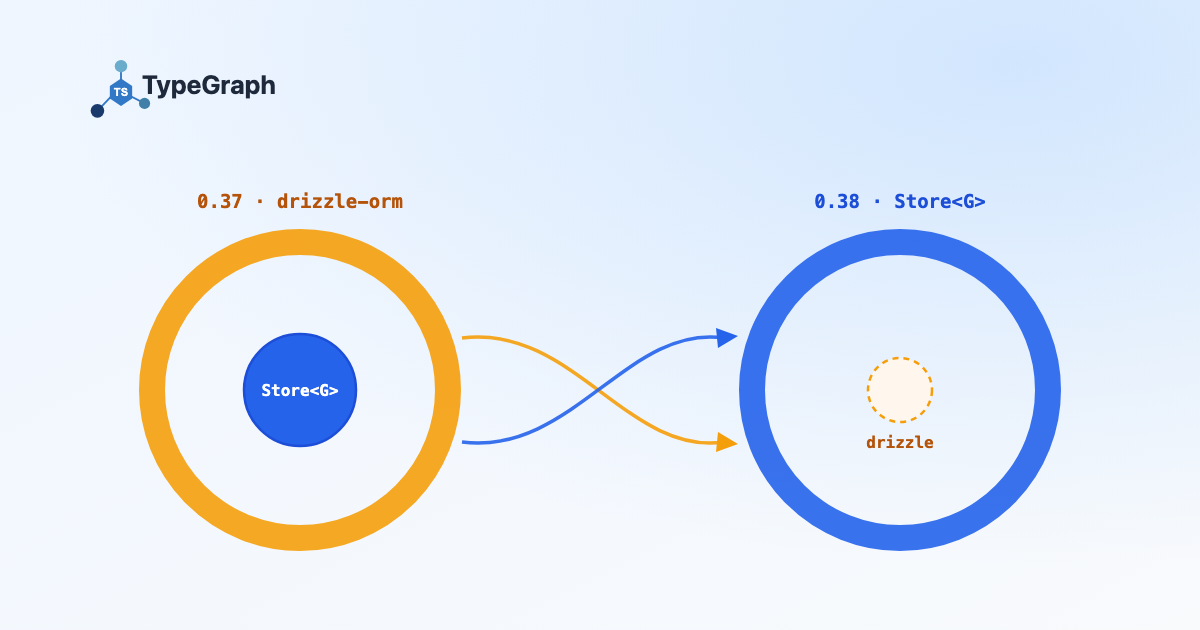
The first versions of TypeGraph depended on Drizzle and assumed the database
underneath was either a pg pool or better-sqlite3. That held up until
people started running it on Cloudflare D1, inside Durable Objects, over
Neon’s HTTP driver, in PGlite, and on engines that speak the Postgres wire
protocol but handle locking very differently from Postgres.
Each of those broke an assumption somewhere, usually as a SQL error from deep inside a query the engine couldn’t run, and over three releases (0.38, 0.51, and 0.57) I’ve been removing those assumptions. This post covers all three: how Drizzle became optional, how a backend can now declare what it can’t do before a query fails, and how an engine that locks differently can describe that to TypeGraph.
Drizzle is an adapter now
Section titled “Drizzle is an adapter now”Before 0.38, every Store<G> carried Drizzle’s types whether your code
touched them or not. A strict TypeScript project that only ever called
store.nodes.Person.create(...) still had to resolve Drizzle’s dialect
declarations to typecheck, which is a lot of ORM to pull into your type
checking just to create a node.
Now the portable Store<G> has no Drizzle in it. The managed factories own
the connection and hand you a complete store:
import { createLocalSqliteStore } from "@nicia-ai/typegraph/sqlite/local";
const store = await createLocalSqliteStore(graph, { path: "./graph.db" });const alice = await store.nodes.Person.create({ name: "Alice" });
created: LBPSjEoGPqI0P3C6kaJ5M Alicecapabilities.execution.interactiveTransactions: truecreateLocalPgliteStore does the same for Postgres-in-WASM. The full graph
API is there, store.transaction(...) included.
When you do want to write your own tables on the same connection, you opt in
with createAdapterStore, and tx.sql hands you the native transaction:
await store.transaction(async (tx) => { await tx.nodes.Document.update(documentId, props); if (tx.sqlAvailability !== "available") { throw new Error(`Native transaction unavailable: ${tx.sqlAvailability}`); } await tx.sql.insert(documentVersions).values(versionRow);});sqlAvailability is a discriminant because raw SQL is sometimes off on
purpose: on a history-enabled store, writing around TypeGraph would skip
recorded-time capture, so tx.sql isn’t available there.
Drizzle is now an optional dependency
Section titled “Drizzle is now an optional dependency”In 0.51 drizzle-orm became an optional peer dependency, and ten
entrypoints don’t need it installed at all: the root, backend, core,
schema, indexes, graph-extension, interchange, profiler,
graph-merge, and provenance.
That list is enforced by tests: a fixture imports all ten with drizzle-orm
missing from node_modules, and source and build-output checks fail if an
import ever drags it back in. The last three routes to Drizzle
(recorded-time migration DDL, a claim comparison, and some removal-statement
builders) moved to portable code with golden tests pinning byte-identical SQL
on both dialects.
If you use a managed store or a /adapters/drizzle/... entrypoint you still
need Drizzle, and if your package manager skips optional peers you’ll need to
install it yourself. The managed factories tell you so with a typed error
that includes the npm install command, instead of a module-resolution stack
trace.
Backends say what they can’t do
Section titled “Backends say what they can’t do”Removing the dependency was the easier part. The harder problem is that TypeGraph emits SQL some engines can’t run, and it used to find that out in production, halfway through a query.
Recursive CTEs are the clearest case, since variable-length traversals, subgraph extraction, and a few identity reads depend on them. An engine without them can now say so:
const capabilities: Partial<BackendCapabilities> = { recursiveTraversal: { supported: false, reason: "engine has no WITH RECURSIVE / equivalent", },};With that declared, the operations that need recursion throw a
ConfigurationError naming the operation, instead of sending the engine SQL
it can’t parse. weightedShortestPath falls back to walking the path one hop
at a time, which returns the same answer in more round trips. Leaving the
capability out means it’s supported, so every existing custom backend keeps
working as it did.
How your engine keeps writers apart
Section titled “How your engine keeps writers apart”Some writes (Operational Identity, and the recorded-time clock behind
history and revisionTracking) need exactly one writer per graph at a
time. TypeGraph used to pick the lock by checking which dialect it was
talking to, which went badly if your engine said “postgres” but had no
advisory locks.
Now the backend declares how it keeps writers apart, which for the two bundled engines is one line each:
// PostgreSQLwriteFence: { mechanism: "advisory", drain: "table-lock" }// SQLitewriteFence: { mechanism: "engine-serialized" }A custom backend that hosts identity or recorded history without declaring one is rejected at construction, and the error message prints the line to add for your dialect.
0.57 added two more mechanisms. caller-serialized is your promise that
nothing else writes to the database; TypeGraph enforces the in-process half
and trusts you with the rest. row is for engines with no advisory locks at
all: TypeGraph takes the lock by upserting a row in its own
typegraph_fences table. If your engine settles write conflicts at commit
time rather than blocking, declare conflict: "commit-time" and TypeGraph
retries its own transactions as a whole unit when they lose, up to three
attempts.
Engine profiles
Section titled “Engine profiles”The piece I’m happiest about is that 0.57 made the two bundled backends
data. createPostgresBackend and createSqliteBackend are now the same
function, createSqlBackend, applied to an engine profile: the dialect, how
it executes, how it provisions, and what it declares. That means you can take
a bundled profile, change what’s different about your engine, and get a real
backend:
import {  buildSqliteEngineProfile,  createSqlBackend,  deriveEngineProfile,} from "@nicia-ai/typegraph/adapters/drizzle/engine";import { createLocalSqliteBackend } from "@nicia-ai/typegraph/adapters/drizzle/sqlite/local";
const { db } = createLocalSqliteBackend();const base = buildSqliteEngineProfile(db);
const derived = deriveEngineProfile(base, {  declaredCapabilities: {    ...base.declaredCapabilities,    writeFence: {      mechanism: "row",      drain: "quiescent",      conflict: "commit-time",    },  },});const backend = createSqlBackend(derived);
console.log(backend.capabilities.execution?.unitOfWork);// "optimistic-retry"
(It’s SQLite here only because that’s what runs on a laptop.) You never set
unitOfWork yourself; TypeGraph works it out from what the engine declared
rather than guessing from the engine’s name.
Derivation is narrow on purpose. You can override declared capabilities, the
lock SQL, and a handful of runtime hooks, but not dialect or execution,
because the bundled builders capture those in more than one place, and I’d
rather throw at construction than hand you a backend that’s half one engine
and half another.
One error for “you lost the race”
Section titled “One error for “you lost the race””A Postgres serialization failure or deadlock used to surface as whatever the
driver felt like throwing. Now every conflict comes back as
TransactionConflictError, with the driver error as cause, and
store.transaction() can retry for you:
// SQLite never raises 40001; this stands in for what PostgreSQL would.function serializationFailure(): Error {  return Object.assign(new Error("could not serialize access"), {    code: "40001",  });}
let attempts = 0;await store.transaction(  async (tx) => {    attempts += 1;    await tx.nodes.Account.create({ owner: "ada", balance: 100 });    if (attempts < 3) throw serializationFailure();  },  { retry: { attempts: 3 } },);console.log(attempts, (await store.nodes.Account.find()).length);// 3 1 — two rolled-back attempts left nothing behind
The callback reruns from the top, so it has to be safe to run more than once: read inside it, don’t reuse values from outside it, and don’t cause side effects that escape the transaction.
Branches your host can copy
Section titled “Branches your host can copy”branch() normally copies a graph by streaming it into a fresh database.
0.57 also adds forkedWorkingCopyStrategy, which hands the copy to whatever
your host is good at, such as a file copy, CREATE DATABASE ... TEMPLATE, or
a provider’s branch API. Because the fork is a physical copy of the database,
it keeps things a streamed copy can’t, including recorded history, so a forked
branch can answer asOfRecorded queries from before the fork was taken.
What isn’t there yet
Section titled “What isn’t there yet”You can’t build an engine from scratch yet. deriveEngineProfile adapts one
of the two bundled profiles, and building a profile from nothing needs pieces
that aren’t exported. No third engine has been run through this in production
yet either: the commit-time retry path is tested by injecting conflicts into
real SQLite and PGlite transactions rather than against an engine that
produces them on its own. If you have one, I’d like to hear how it goes.
Upgrading
Section titled “Upgrading”From 0.37, the Drizzle-specific entrypoints moved under /adapters/drizzle
and the old paths are gone rather than aliased:
| 0.37 | 0.38 and later |
|---|---|
/sqlite |
/adapters/drizzle/sqlite |
/sqlite/local |
/adapters/drizzle/sqlite/local |
/sqlite/libsql |
/adapters/drizzle/sqlite/libsql |
/postgres |
/adapters/drizzle/postgres |
/postgres/pglite |
/adapters/drizzle/postgres/pglite |
/sqlite/local and /postgres/pglite now mean the managed store factories.
If you read tx.sql, switch to createAdapterStore /
createAdapterStoreWithSchema; if you don’t, nothing changes.
Custom backend authors: capabilities.pessimisticLocks is now
capabilities.writeFence, and conflicts should be matched as
TransactionConflictError rather than by SQLSTATE. The
0.57.0 changelog has the full list.
Try it
Section titled “Try it”- Backend Setup: entrypoints, capabilities, and the parity matrix
- Write fence declaration: every mechanism and what each error means
- Authoring an engine profile: the derivable fields and worked examples
- GitHub
Stay in the loop
Occasional updates on new features, guides, and releases. No spam.