

Five Bugs That Didn't Crash
A bug that crashes is the easy kind, because it tells you where it is. The ones I worry about in a database library are the ones that return a reasonable-looking answer (zero rows, a successful write, a clean startup) while the data is wrong, so you find out weeks later or not at all.
Over the last stretch of releases (0.44 through 0.50, plus one older fix) I’ve fixed five of those in TypeGraph. None of them warrants a post of its own, but together they show how I want the library to behave, and one of them you could hit just by doing what TypeGraph’s own error message told you to do.
Rows that exist at no point in time
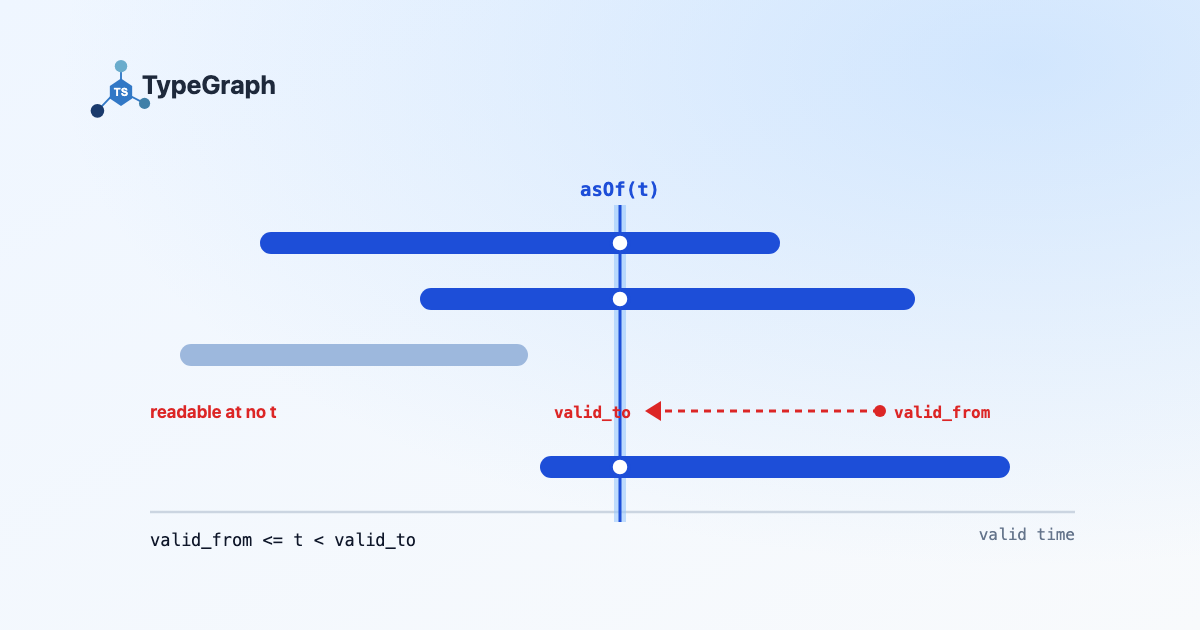
Section titled “Rows that exist at no point in time”A valid-time window is half-open, so asOf(t) returns a row when
valid_from <= t < valid_to. If you backfilled a record you knew had already
ended, you’d pass a validTo in the past and no validFrom, and the write
stamped its own instant as validFrom, which put the start after the end. A
window that runs backwards contains no t at all, so the row was stored,
counted, and exported, but no temporal read could ever return it.
Since 0.48, a write that creates a row (or resets its window) with a validTo
at or before its own instant and no validFrom stores no lower bound instead,
so the row reads as “ended at T, start unknown”, which is what you meant. A
future validTo behaves as before. Custom backends can call the same helper
the built-in ones use, resolveStampedValidityLowerBound, so the rule lives
in one place.
While I was in there, 0.47 added the thing people were faking with
delete-and-recreate: clearValidTo: true reopens a window you closed too
early, on the same row, with oneActive edges rechecked because reopening can
create a second active edge.
await store.nodes.Employment.updateById(employmentId, { patch: { department: "Research" }, clearValidTo: true,});Upgrading doesn’t repair old rows, on purpose
Section titled “Upgrading doesn’t repair old rows, on purpose”Older versions could store inverted windows, and upgrading leaves them alone. I think that’s the right call: an upgrade that made invisible rows start appearing in historical queries would change your reports and replays without telling you which rows had moved, which is its own quiet bug.
So the repair is an explicit operator action, with a dry run:
import { repairInvertedValidityWindows } from "@nicia-ai/typegraph";
const report = await repairInvertedValidityWindows({  backend: anyBackend,  relations: "live-and-recorded",  mode: "report",});// report.counts.recordedNodes === undefined means NOT SCANNED, never "clean"
mode: "apply" rewrites what report counted. Stop writers first, pass the raw
backend on a history-enabled store, and repair "live-and-recorded" unless you
have a reason not to, because fixing only the live rows leaves the recorded
history carrying the same backwards window and asOfRecorded will keep serving
it. The runbook has
the details.
Constraints that importGraph walked straight past
Section titled “Constraints that importGraph walked straight past”TypeGraph lets you declare hierarchy-wide uniqueness
(scope: "kindWithSubClasses"), disjointWith(Person, Organization), and
edge cardinality (one, unique, oneActive). Plain per-kind uniqueness was
always backed by a real database key, but these three were enforced by a
writer that took the per-graph write lock, checked, and then wrote.
That works only as long as every writer takes the lock, and importGraph
didn’t. It also skipped the disjointness and cardinality checks entirely, so
an import could commit a Person and an Organization with the same id, or
three edges on a cardinality: "one" relationship, and report success. Import
is also the path most likely to be carrying data you didn’t write yourself.
As of 0.50, each of those constraints is also backed by a reservation row
whose primary key admits exactly one owner. Taking the constraint means
winning that insert, so a writer holding no lock still loses the race it
should lose. Import now enforces all three and reports rejected rows in its
errors like any other violation. Every store and import write also goes
through a single write pipeline now. Import had drifted because it had its own
hand-built write path, and nobody noticed which rules it was missing.
There are two caveats. This only covers writes that go through TypeGraph, so raw SQL inserting into the node or edge tables skips the reservation. And databases created before 0.50 need the new edge-claims table, which the normal bootstrap or the generated migration SQL provides.
As with validity windows, the fix prevents new violations and leaves old ones where they are. To find those:
for (const violation of await store.verifyConstraintFences()) { console.warn(violation.family, violation.target.axis, violation.target.key);}The audit reads the nodes and edges themselves rather than the new reservation tables, because a database written before those tables existed has no reservations in it, and an audit that only looked there would report zero violations on exactly the data you’re worried about. It writes and repairs nothing, since picking which of two conflicting rows survives destroys data either way, and that decision should be yours.
A search index that said it was fine
Section titled “A search index that said it was fine”Fulltext and vector search need their own tables. TypeGraph creates them on first use and writes a marker row saying so, and from then on it trusted the marker without checking that the tables were still there.
When one went missing out of band (a partial restore, a migration that recreated a schema, or an edge runtime that lost a file), the store opened cleanly and then failed on the first search with a raw driver error about a missing relation. This mostly showed up on Cloudflare Durable Objects, where one SQLite database per tenant means thousands of small databases that nobody is watching individually.
That error is now a ContributionUnavailableError with
state: "physical-storage-missing" and rebuild guidance. The check only runs
on the error path, so healthy stores don’t pay for it. There’s also a
three-step ladder for when search is broken, from cheapest to most drastic:
| Step | Call | Writes |
|---|---|---|
| Probe | store.probeContributions() |
Nothing. Safe on a replica |
| Repair | store.repairContributions() |
Marker rows, IF NOT EXISTS |
| Rebuild | store.rebuildContribution("fulltext") |
Deletes and refills this graph’s rows |
Start at the top and stop when the probe says ready. Rebuild is the only
fix when the table exists in a shape the current code no longer produces, and
it needs a maintenance window. Vector storage can’t be rebuilt, because the
embeddings exist only in the table a rebuild would drop, so TypeGraph won’t
drop it. The
troubleshooting guide
walks through each state.
A migration that deleted your runtime kinds
Section titled “A migration that deleted your runtime kinds”This one stings. Runtime schema evolution
lets an agent add node and edge kinds with store.evolve(), and those kinds
live in the stored schema rather than in your TypeScript graph definition.
migrateSchema() committed whatever graph you passed it, so if you migrated
with your compile-time graph, every kind added at runtime disappeared from the
schema while its rows stayed in the tables where nothing could reach them. The
usual way you’d end up calling migrateSchema() was the library’s own error
message telling you to review the changes and run it, so following my advice
hid your data.
0.44 folds the stored runtime additions in before committing, the same way
store creation already did. It also throws if a migration would drop a kind
that still holds rows, unless you pass { discardDroppedKindRows: true }.
Two races in the same area got fixed alongside it:
- A schema commit could land while another writer was mid-write against the version being replaced. Managed writes now recheck their schema version while holding a lock the commit also needs, so a stale write fails instead of landing against a schema that no longer accepts it.
- Removing a kind and adding it back before its cleanup ran made the old
rows reappear next to the new ones, and the cleanup then skipped them
because the kind was live again.
evolve()now won’t re-add a kind while its cleanup is pending, and cleanup rechecks the schema under the same lock.
An implies() that folded nonsense rows
Section titled “An implies() that folded nonsense rows”This is the older one, from 0.35. implies(edgeA, edgeB) means “a traversal
of edgeB can include edgeA edges”, which only makes sense if edgeA’s
endpoints could stand in for edgeB’s. Nothing checked that, so this was
accepted:
edges: { authored: { type: authored, from: [Author], to: [Paper] }, covers: { type: covers, from: [Paper], to: [Topic] },},ontology: [implies(authored, covers)],and a covers traversal with expand: "implying" would fold in rows that
start at an Author. Now it fails when the graph is built or loaded:
ConfigurationError: implies("authored", "covers") is endpoint-incompatible:from kind(s) [Author] declared on "authored" cannot be assigned to any of"covers"'s from kind(s) [Paper].The check also runs on schemas loaded from the database, so a bad relation
saved by an older version fails on first load after upgrading. The same
release made projected ids keep their NodeId<N> brand through .select()
and gave every fixed-shape error class a typed details, so fewer mistakes
make it to runtime in the first place.
What they have in common
Section titled “What they have in common”All five fixes follow the rules I now hold the whole library to. If TypeGraph can’t do what you asked, it throws and tells you why rather than returning an empty result that looks like a clean one, and it doesn’t rewrite your data behind your back, even to fix it. You get a report first and decide what to do.
Try it
Section titled “Try it”- Repairing inverted validity windows
- Claim relations, and what they do not promise
- Contribution health: probe, repair, rebuild
- Schema Management: migrations and kind removal
Stay in the loop
Occasional updates on new features, guides, and releases. No spam.