

An Infinite Supply of Graph Databases
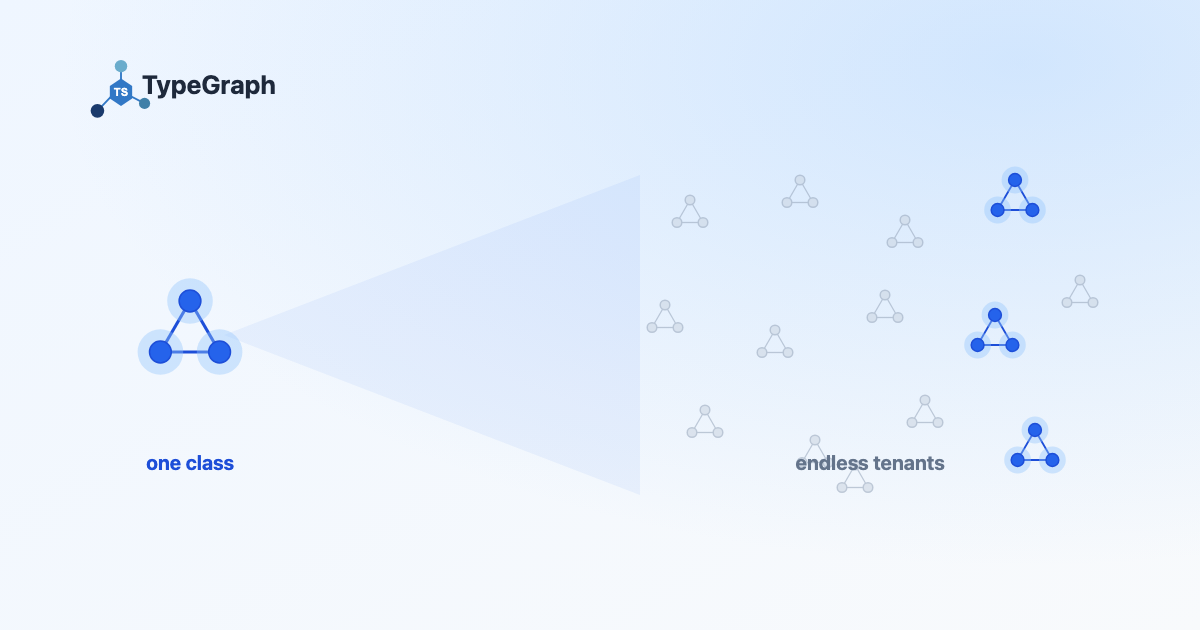
TypeGraph turns a SQLite (or PGlite, or Postgres) connection into a typed property graph. If you point that connection at a Cloudflare Durable Object’s own storage, you no longer have to provision the database at all. Every user, agent conversation, or workspace can have its own graph database without anyone ever creating it, and I think that’s a lot of fun.
I built a companion repo to show it off,
cf-do-typegraph. It wires
TypeGraph into a single Durable Object class and runs three real apps on
top, entirely on your laptop under wrangler dev. It’s MIT-licensed.
Naming is the provisioning step
Section titled “Naming is the provisioning step”Here’s the whole multi-tenant boundary:
// the whole multi-tenant boundary, trimmed from src/worker.tsconst stub = env.GRAPH_DO.get(env.GRAPH_DO.idFromName(`${example}:${tenant}`));return stub.fetch(request); // that tenant's graph, and nothing else, lives hereidFromName is effectively the provisioning API. The Durable Object it names,
and the private SQLite database inside it, comes into existence on the first
request and hibernates as soon as nothing is using it, so there’s no
CREATE DATABASE, no row to add to a tenants table, and no migration to run
against a database that didn’t exist five minutes ago. Giving every user,
agent, or document its own graph stops being a capacity-planning question,
because each one is just a name.
Minting a lot of them is just a loop:
curl -X POST "localhost:8787/api/spawn/notes?count=25&prefix=demo"{ "example": "notes", "seeded": ["demo-1", "demo-2", "...", "demo-25"] }curl "localhost:8787/api/notes/demo-7/search?q=hibernation" # its own private graphThat endpoint forwards 25 /seed requests to 25 different names and lets
each Durable Object materialize when its request arrives. There’s nothing
more to it than that.
Isolation and shared transactions
Section titled “Isolation and shared transactions”Making each tenant a Durable Object has two consequences that matter more than the provisioning trick.
Isolation is physical. Each tenant’s SQLite file is its own ctx.storage
rather than a slice of a shared table. The usual SaaS approach is a
tenant_id column plus a promise that every query remembers its
WHERE tenant_id = ?, but here there’s no shared table to put that column in,
so a bad join or a missing filter can only ever see one tenant’s data.
The graph and the app’s data live in the same file and the same transaction. The Durable Object boots its store the same way on every request:
createSqliteBackend(drizzle(this.ctx.storage));ctx.storage is the same SQLite the application would use for its regular
tables, and TypeGraph doesn’t need a separate connection or service, so
writing an app row and the graph edge that describes it can be one
store.transaction(...). There’s no sync job between your data and your
graph, and nothing for them to drift apart on.
Three apps, one Durable Object class
Section titled “Three apps, one Durable Object class”The repo runs the same GraphDO class three ways, distinguished only by
what you name the tenant. I picked each example because it needs a query
that’s painful to hand-write in SQL.
authz: a graph per workspace
Section titled “authz: a graph per workspace”Zanzibar-style permission checks are reachability questions, and
TypeGraph’s ontology does the reasoning you’d otherwise hand-roll in a
WITH RECURSIVE:
ontology: [ implies(owner, editor), // owner ⇒ editor ⇒ viewer implies(editor, viewer), inverseOf(memberOf, hasMember), // group membership, read backwards, zero stored reverse edges],A permission check is one shortestPath call over the edge kinds the
requested relation implies:
curl "localhost:8787/api/authz/acme/check?user=alice&relation=editor&doc=roadmap"{ "allowed": true, "relation": "editor", "subject": "user:alice", "via": { "grantSubject": "group:staff", "grantRelation": "editor", "grantTarget": "folder:engineering" }, "pathNodeIds": [ "user:alice", "group:eng", "group:staff", "folder:engineering", "folder:specs", "doc:roadmap" ], "pathEdgeKinds": ["memberOf", "memberOf", "editor", "parentOf", "parentOf"]}Alice never got a direct grant on that doc, and the answer comes with the
path that proves she has access anyway: nested group membership (alice →
eng → staff), one group-level editor grant, and two levels of folder
inheritance, all inferred at query time from five stored edges without a
permissions table.
notes: a graph per user
Section titled “notes: a graph per user”This one is a personal wiki with [[wiki-links]], and the fun part is that
FTS5 runs inside the Durable Object’s own SQLite, so there’s no search
service to keep warm:
curl "localhost:8787/api/notes/me/search?q=reachability"{ "hits": [ { "id": "note:reachability", "title": "Reachability", "score": "...", "snippet": "<mark>Reachability</mark> asks whether you can get from one node to another..." } ]}Backlinks don’t need any stored rows. The graph only writes a forward linksTo
edge when a note contains [[Some Target]], and one ontology declaration
lets a linkedFrom traversal read those same edges backwards:
ontology: [inverseOf(linksTo, linkedFrom)],There’s no second edge to keep in sync, so backlinks can’t drift from the links that produced them.
agent-memory: a graph per conversation
Section titled “agent-memory: a graph per conversation”Each session is its own graph, seeded by replaying a hand-written conversation one message at a time:
"I'm Ada, and I'm PMing the Halo launch.""Grace is my lead engineer — we've shipped three products together."..."New development: we're partnering with Northwind, and Grace is their main contact."That eighth message is my favorite part of the repo. Organization isn’t a
node kind in the compile-time schema, so it arrives at runtime, gets validated
the same way an LLM’s proposed schema change would be, and is applied live:
const validation = validateGraphExtension(evolution.extension, { strict: true,});current = await current.evolve(validation.data);The graph grows a new node kind and a new worksAt edge kind in the middle
of a conversation, while the Durable Object is running. The change is
persisted, so it’s still there the next time the object wakes from
hibernation. And because the store boots with { history: true }, the same
graph can answer “what did the agent believe after message 4?”, before
Northwind existed, by reading at a recorded point in time instead of the
live state.
The same pattern without Cloudflare
Section titled “The same pattern without Cloudflare”The underlying idea, a small, typed graph database per tenant, addressed by name, works well whenever tenants are numerous, mostly idle, and shouldn’t share a query surface. Durable Objects make it especially easy (SQLite at the edge, isolated per object, and hibernating for free), but TypeGraph doesn’t know or care that one is underneath, and the same pattern works with:
- A directory of SQLite files. One file per tenant, opened through
createLocalSqliteStore. Provisioning is choosing a file path. - A pool of PGlite files. Postgres-in-WASM via
createLocalPgliteStore, one file per tenant, no server process. - A database per Neon branch. Real network Postgres, with the standard
createPostgresBackendpointed at a different connection string per tenant, provisioned through Neon’s API instead ofidFromName.
I built the demo on Durable Objects because they need the least infrastructure to try: there’s no server to run, and you don’t need an account to develop against them.
Tested against the real thing
Section titled “Tested against the real thing”Every example runs its tests against real Durable Objects via
@cloudflare/vitest-pool-workers, not mocks, including a cross-tenant
isolation test that seeds one tenant and checks that a same-shaped,
differently named tenant reads back empty. pnpm dev runs the whole thing
(landing page, live force-directed graph view, all three APIs) locally for
free. Workers AI, the one billable piece, is only used for optional
semantic search and entity extraction, and ships commented out.
Try it
Section titled “Try it”- cf-do-typegraph:
pnpm install && pnpm dev, then openlocalhost:8787 - Bring Your Own Database: the backend abstraction that lets the same store run on a different SQLite underneath
- Agent Memory That Knows Why It Believes Things:
the bitemporal history behind the
agent-memoryreplay - An Agent That Grows Its Own Schema:
store.evolve(), the mechanism behind the liveOrganizationextension - GitHub
Stay in the loop
Occasional updates on new features, guides, and releases. No spam.