

Letting an Edge's Targets Depend on Its Source
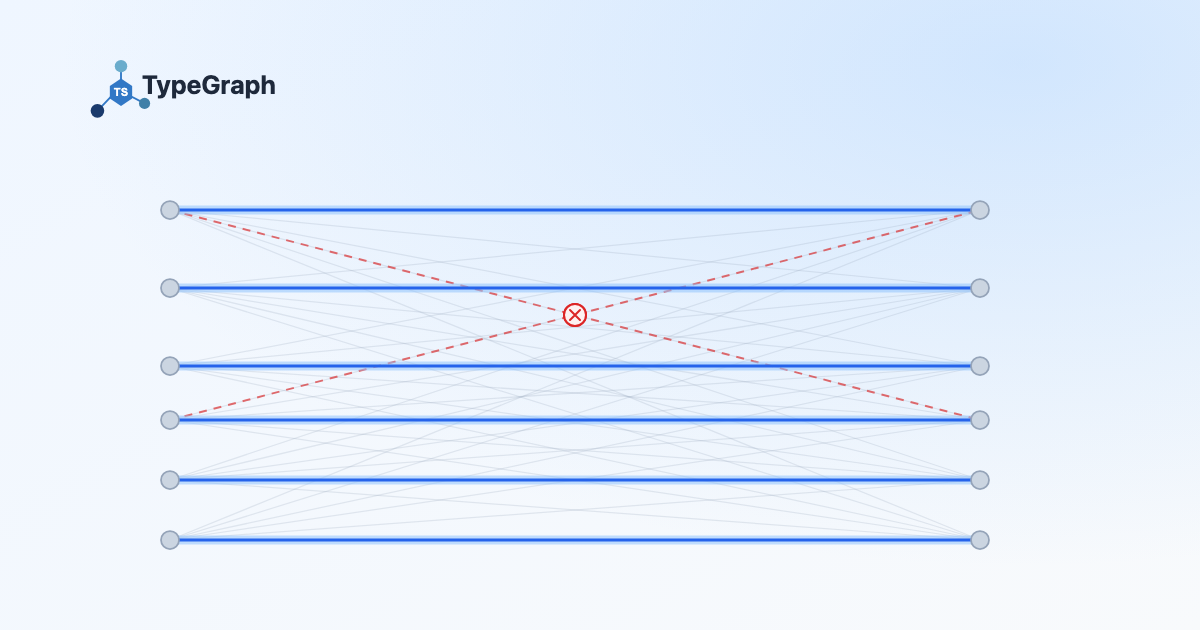
This schema looks reasonable, but it allows more than you probably meant:
const assignedTo = defineEdge("assignedTo", { from: [Employee, Student], to: [Department, Course],});You want employees assigned to departments and students assigned to courses,
but array-valued from and to declare the Cartesian product, so every
source may point at every target and both
store.edges.assignedTo.create(student, department) and
create(employee, course) succeed. Until 0.55 the only way to rule those two
combinations out was to split the edge into two kinds and query them
separately.
Say which source gets which targets
Section titled “Say which source gets which targets”to can now be a map from source kind to its own allowed targets:
const assignedTo = defineEdge("assignedTo", {  from: [Employee, Student],  to: {    Employee: [Department],    Student: [Course],  },});
const graph = defineGraph({  id: "assignments",  nodes: {    Employee: { type: Employee },    Student: { type: Student },    Department: { type: Department },    Course: { type: Course },  },  edges: { assignedTo },});
create(employee, department) and create(student, course) still work, and
the other two combinations fail before anything is written:
EndpointPairError: assignedTo: undeclared endpoint pair { edgeKind: "assignedTo", endpoint: "pair", fromKind: "Employee", toKind: "Course", allowedPairs: [ { from: "Employee", to: "Department" }, { from: "Student", to: "Course" }, ] }In typed code you won’t get that far, because the collection’s create()
signature narrows per source and handing it an employee and a course is a
compile error. The runtime check covers the paths a type checker can’t see, such
as dynamic collections, bulk writes, and imports. An endpoint kind that isn’t in
from at all still throws the existing EndpointError; EndpointPairError is
specifically for two kinds that are each valid but were never declared together.
The map itself is checked when you call defineEdge(): every kind in from
needs an entry, extra keys aren’t allowed, and no entry may be empty. A
mistake throws ConfigurationError at that point rather than turning up later
as a confusing write failure.
Narrowing, never widening
Section titled “Narrowing, never widening”An edge’s map is its outer bound, and a graph or a runtime graph extension can register a narrower version:
edges: { assignedTo: { type: assignedTo, from: [Employee], to: { Employee: [Department] }, // this graph has no students },}A registration can’t add a pair the edge never declared. That includes the
easy mistake of registering the old array form, to: [Department, Course],
against an edge whose map only allows the correlated pairs, which would
quietly re-admit the cross-pairs the map is there to forbid, so it’s rejected.
Subclasses are checked against the declared pairs. With SubTask subClassOf Task and an edge that allows Task: [Task], every mix of Task and SubTask
works, but a SubTask can’t borrow a target that only some other source kind is
allowed.
Bulk writes are all or nothing
Section titled “Bulk writes are all or nothing”await store.edges.assignedTo.bulkCreate([ { from: employeeA, to: departmentA }, // valid { from: employeeB, to: courseA }, // undeclared pair]);// throws EndpointPairError; store.edges.assignedTo.count() is still 0A single undeclared pair rejects the whole batch, because committing the valid half and quietly dropping the rest would leave you guessing which rows made it.
Pairs are stored in the schema
Section titled “Pairs are stored in the schema”The pairs are stored in the serialized schema, and declaring them in a
different key order doesn’t change the schema hash. Replacing an array to
with a map removes pairs even though it removes no kinds, so it counts as a
breaking change and follows the same migration rules as any other breaking
edge change. See
endpoint pair changes.
Try it
Section titled “Try it”- Source-Dependent Targets: the full reference
EndpointPairError- Endpoint pair changes
- GitHub
Stay in the loop
Occasional updates on new features, guides, and releases. No spam.