

The Cheapest Citation Lineage Isn't the Shortest One
When I introduced TypeGraph I said there was no PageRank and no community detection, and that if you needed those you wanted a real graph database. That’s still partly true (more on that at the end), but as of 0.38 the list is a lot shorter.
Until now, store.algorithms answered questions about two nodes at a time,
like how to get from A to B or what’s within three hops of A. Some questions
need the whole graph at once: whether a dataset is one connected body or
several islands, which nodes matter most structurally rather than by raw
count, or whether communities emerge from the topology on their own.
Answering those means running an algorithm round after round over the entire
graph, from one consistent snapshot, until it converges. That needs more
machinery than a single traversal, including a pinned transaction, a temporary
working table, and a clear rule for what happens when the rounds don’t
settle. 0.37 added
weaklyConnectedComponents and weightedShortestPath. 0.38 added global and
personalized pageRank and deterministic labelPropagation, the same
algorithm the LDBC Graphalytics benchmark uses for community detection. All
five run as SQL against the store, so you don’t export the graph to a separate
analytics engine and keep a second copy in sync.
They’re also a lot of fun to play with, so the rest of this post runs them on a small citation graph.
The corpus
Section titled “The corpus”This is the same citation graph as the research-copilot example: 18 landmark ML papers, 55 authors, 14 topics, and 37 real citation edges, from Rumelhart, Hinton & Williams’ 1986 backprop paper through LLaMA in 2023. That example runs point queries; here I run the whole-graph algorithms over the same data.
const backend = createExampleBackend();const [store] = await createStoreWithSchema(graph, backend);// Ingested 18 papers, 55 authors, 14 topics, 37 citation edges.One body of work, or islands?
Section titled “One body of work, or islands?”Treat cites as undirected and partition by connectivity:
const components = await store.algorithms.weaklyConnectedComponents({ edges: ["cites"], nodeKinds: ["Paper"],});18 papers partition into 1 component(s): • component of 18 paper(s), rooted at "Adam: A Method for Stochastic Optimization"Every paper reaches every other through some chain of citations. On a real,
messy dataset this is the sanity check to run first. nodeKinds: ["Paper"]
keeps authors and topics out of it, so more than one component would mean a
separate sub-literature rather than a lightly cited author hanging
off the edge.
The cheapest lineage isn’t the shortest one
Section titled “The cheapest lineage isn’t the shortest one”This is my favorite result in the post, and getting to it took one false start.
Citations always point from a newer paper to an older one, so the obvious edge
weight is yearGap, the number of years a citation reaches back. The trouble
is that every hop steps strictly backward in time, so the gaps along any
route from A to B telescope to exactly A.year - B.year. Every path ties, and
weighting by yearGap is just shortestPath with extra arithmetic.
Squaring the gap breaks the tie. yearGapCost = yearGap² is convex, so one
27-year leap costs 27² = 729 while the same span covered in several small
steps costs much less. The question becomes “what’s the smoothest chain of
ideas between these two papers,” and that’s where weightedShortestPath
starts disagreeing with shortestPath:
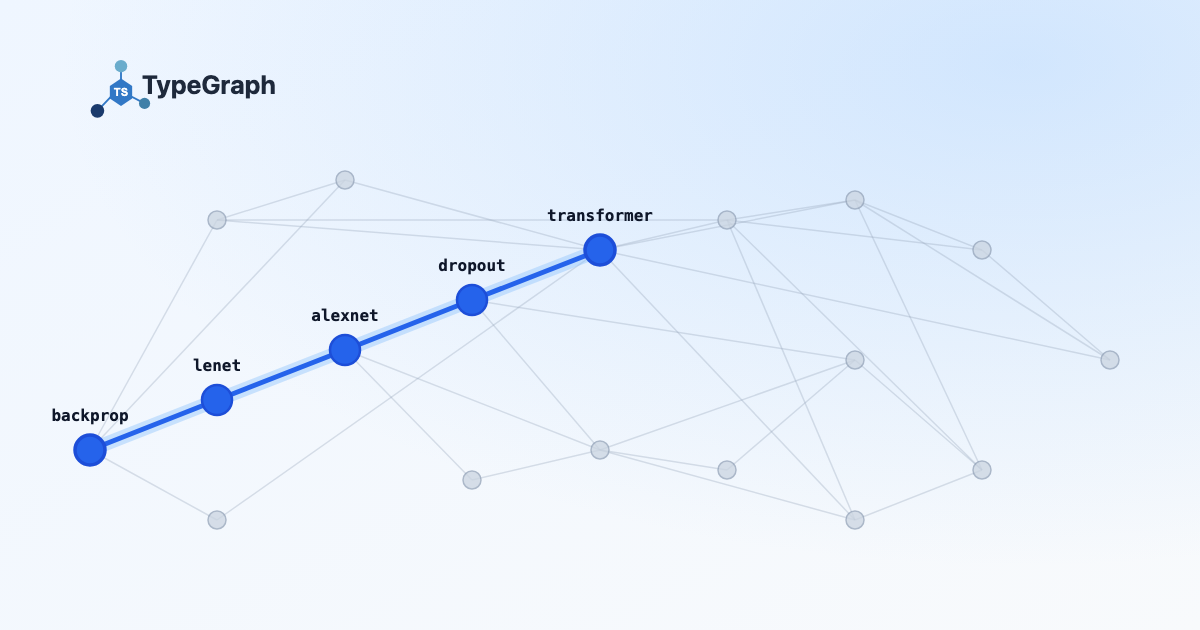
const hopPath = await store.algorithms.shortestPath(from.id, to.id, { edges: ["cites"], maxHops: 10,});const byConvexCost = await store.algorithms.weightedShortestPath( from.id, to.id, { edges: ["cites"], weightProperty: "yearGapCost" },);transformer → backprop: shortestPath (fewest hop): 2 hops transformer(2017) → adam(2014) → backprop(1986) weighted by yearGapCost: 4 hops totalWeight=353 transformer(2017) → dropout(2014) → alexnet(2012) → lenet(1998) → backprop(1986) ◀── more hops, lower convex cost
clip → backprop: shortestPath (fewest hop): 3 hops clip(2021) → simclr(2020) → dropout(2014) → backprop(1986) weighted by yearGapCost: 7 hops totalWeight=359 clip(2021) → gpt2(2019) → bert(2018) → transformer(2017) → dropout(2014) → alexnet(2012) → lenet(1998) → backprop(1986) ◀── more hops, lower convex costThe fewest-hops route from the Transformer paper to backprop makes a 28-year jump through Adam. The convex-cost route takes four smaller steps (Dropout, AlexNet, LeNet) and comes in at less than half the cost. From CLIP it walks seven hops, almost straight down the history of deep learning. Both are legitimate answers to “what’s the best path” between the same two papers, and I like that the convex-cost one reads like a syllabus.
Weights are checked before any traversal round runs, so a negative or
non-numeric yearGapCost anywhere in the selected edges throws
InvalidEdgeWeightError up front instead of producing a wrong answer.
PageRank vs. counting citations
Section titled “PageRank vs. counting citations”A citation count tells you how many papers cite this one. PageRank tells you how much a paper matters given who cites it: a citation from an important paper is worth more, and that carries through the graph.
const pageRankScores = await store.algorithms.pageRank({ edges: ["cites"], nodeKinds: ["Paper"], direction: "out", // random surfer follows citations forward, toward the classics}); PR-rank score cites raw-rank Δ title ──────────────────────────────────────────────────────────────── 1 0.24209 6 1 · Learning representations by back-propagating errors 2 0.09060 3 7 +5 ImageNet Classification with Deep Convolutional N... 3 0.07559 3 6 +3 Efficient Estimation of Word Representations in V... 4 0.07424 4 2 -2 Attention Is All You Need 5 0.05868 4 3 -2 BERT: Pre-training of Deep Bidirectional Transfor... 6 0.05827 1 13 +7 Gradient-Based Learning Applied to Document Recog... 7 0.05818 3 5 -2 Dropout: A Simple Way to Prevent Neural Networks ... 8 0.05592 3 4 -4 Deep Residual Learning for Image RecognitionBackprop wins both rankings, which is no surprise since it’s the root of the whole corpus. The row I find interesting is 6th place. LeNet has exactly one citation in this corpus, which puts it 13th by count, but PageRank moves it up seven places because that one citation comes from AlexNet, which is heavily cited itself. A plain count would treat it like any other citation.
What matters to CLIP, specifically
Section titled “What matters to CLIP, specifically”Personalized PageRank runs the same iteration, but instead of jumping to a random node it keeps jumping back to a seed you choose. The question changes from “important globally” to “important from where CLIP is standing”:
const personalized = await store.algorithms.personalizedPageRank({ edges: ["cites"], nodeKinds: ["Paper"], direction: "out", seeds: [{ id: clip.id, kind: "Paper" }],}); PPR-rank score global-rank Δ title ────────────────────────────────────────────────────────────────── 1 0.25884 17 +16 Learning Transferable Visual Models From Natural ... 2 0.12804 1 -1 Learning representations by back-propagating errors 3 0.09396 5 +2 BERT: Pre-training of Deep Bidirectional Transfor... 4 0.07889 4 · Attention Is All You Need 5 0.06382 3 -2 Efficient Estimation of Word Representations in V... 6 0.05500 9 +3 Language Models are Unsupervised Multitask Learners 7 0.05500 15 +8 A Simple Framework for Contrastive Learning of Vi... 8 0.05500 16 +8 An Image is Worth 16x16 Words: Transformers for I...CLIP itself jumps from 17th to 1st, since every jump lands back on it, and SimCLR and ViT, both cited directly by CLIP and both well outside the global top 10, climb eight places each. Changing only the seed gives you a ranking for a different question, and it’s the one I’d reach for in a “related work” or recommendation feature.
Do research communities fall out?
Section titled “Do research communities fall out?”Label propagation finds communities by having every node adopt the most
common label among its neighbors, round after round, over the undirected
version of cites. Run it strictly first:
const converged = await store.algorithms.labelPropagation({ edges: ["cites"], nodeKinds: ["Paper"], onMaxIterations: "throw", // default});onMaxIterations: "throw" raised GraphAlgorithmConvergenceError —the undirected citation graph oscillates (tree / even-cycle structurethat mirrors labels back and forth).That error is expected. In synchronous label propagation a node doesn’t vote for itself, so a tree-shaped neighborhood (common once you flatten a citation DAG into an undirected graph) can flip two labelings back and forth forever, and more iterations won’t fix it. The default throws rather than handing you whatever labels the last round happened to land on. If you want that fixed-round answer, which is what the LDBC Graphalytics benchmark specifies, ask for it:
const fixedRound = await store.algorithms.labelPropagation({ edges: ["cites"], nodeKinds: ["Paper"], onMaxIterations: "return",});3 communities:
── community of 7 ── Adam: A Method for Stochastic Optimization [Optimization] Learning representations by back-propagating errors [Optimization, DeepLearning] Dropout: A Simple Way to Prevent Neural Networks ... [DeepLearning, Optimization] Gradient-Based Learning Applied to Document Recog... [CNN, ComputerVision] Sequence to Sequence Learning with Neural Networks [RNN, NLP, DeepLearning] Very Deep Convolutional Networks for Large-Scale ... [CNN, ComputerVision] Efficient Estimation of Word Representations in V... [Embeddings, NLP]── community of 7 ── BERT: Pre-training of Deep Bidirectional Transfor... [Transformer, NLP, SelfSupervised] Learning Transferable Visual Models From Natural ... [Contrastive, MultiModal, ComputerVision] Chain-of-Thought Prompting Elicits Reasoning in L... [LanguageModel, Reasoning, NLP] Language Models are Unsupervised Multitask Learners [Transformer, NLP, LanguageModel] LLaMA: Open and Efficient Foundation Language Models [Transformer, LanguageModel, NLP] Attention Is All You Need [Transformer, Attention, NLP] An Image is Worth 16x16 Words: Transformers for I... [Transformer, ComputerVision, DeepLearning]── community of 4 ── ImageNet Classification with Deep Convolutional N... [CNN, ComputerVision, DeepLearning] Momentum Contrast for Unsupervised Visual Represe... [Contrastive, SelfSupervised, ComputerVision] Deep Residual Learning for Image Recognition [CNN, ComputerVision, DeepLearning] A Simple Framework for Contrastive Learning of Vi... [Contrastive, SelfSupervised, ComputerVision]The algorithm only saw undirected cites edges (the topic tags are printed
for you and were never fed to it), yet it separated the optimization and
classic-vision foundations, the transformer and language-model era, and the
contrastive self-supervised vision cluster purely from who cites whom.
What’s still missing
Section titled “What’s still missing”Shortest path (weighted and unweighted), reachability, neighborhoods,
degree, connected components, label propagation, and global and personalized
PageRank cover a lot of ground, but strongly connected
components, topological sort, betweenness/closeness/eigenvector centrality,
and Louvain/Leiden community detection aren’t in store.algorithms. For
those, pull the edge list out with .query().traverse() or
store.subgraph() and hand it to an in-memory library like
graphology.
Scale matters too. These run as rounds of SQL, which keeps everything in one database and is fine for graphs the size most applications have, but on millions of edges the engines that hold the graph in a specialized in-memory index are orders of magnitude faster at whole-graph work. The benchmark post has the numbers, including the unflattering ones.
Try it
Section titled “Try it”- Graph Algorithms: every algorithm, shared options, temporal behavior, and PageRank tolerance notes across backends
- Research Copilot: the same corpus, run through the point-query algorithms
- Example 32: the runnable source behind this post
- GitHub
Stay in the loop
Occasional updates on new features, guides, and releases. No spam.