

Agent Memory That Knows Why It Believes Things
Say a vuln-feed agent in your overnight security pipeline flags 60 services as shipping a vulnerable library, blocks their deploys, opens fix PRs, and pages the owning teams. In the morning someone notices that the feed had a bad package-name mapping, which pinned a real CVE to the wrong package across a whole class of entries. What should happen to those 60 flags?
Deleting all of them is wrong, because some were independently confirmed by a SAST run or an SBOM check and those services really are vulnerable. Leaving them is also wrong, because most were only ever the feed talking, and they’re blocking shipments and paging people for nothing. What you need is the blast radius: which of the 60 flags depend only on the feed, and which have other evidence behind them.
Most agent memory can’t answer that, because “memory” today usually means retrieval: embed everything, fetch the nearest neighbors, and let the model sort it out. That works for recall, but a vector store only keeps what was said. It has no record of why something was concluded, or of what should happen to a conclusion when one of its sources turns out to be wrong. You could live with that when an agent was a single chat transcript, but not once a fleet of agents writes into shared memory and acts on it.
Over the last few releases I built the layer that answers the question: a second temporal axis (0.33), provenance-backed retraction on top of it (0.34), and the hardening that makes both hold up under real load (0.39 and 0.40). I’m really happy with how this one came out.
The blast radius, as a query
Section titled “The blast radius, as a query”With the provenance layer, the support structure is right there in the graph:
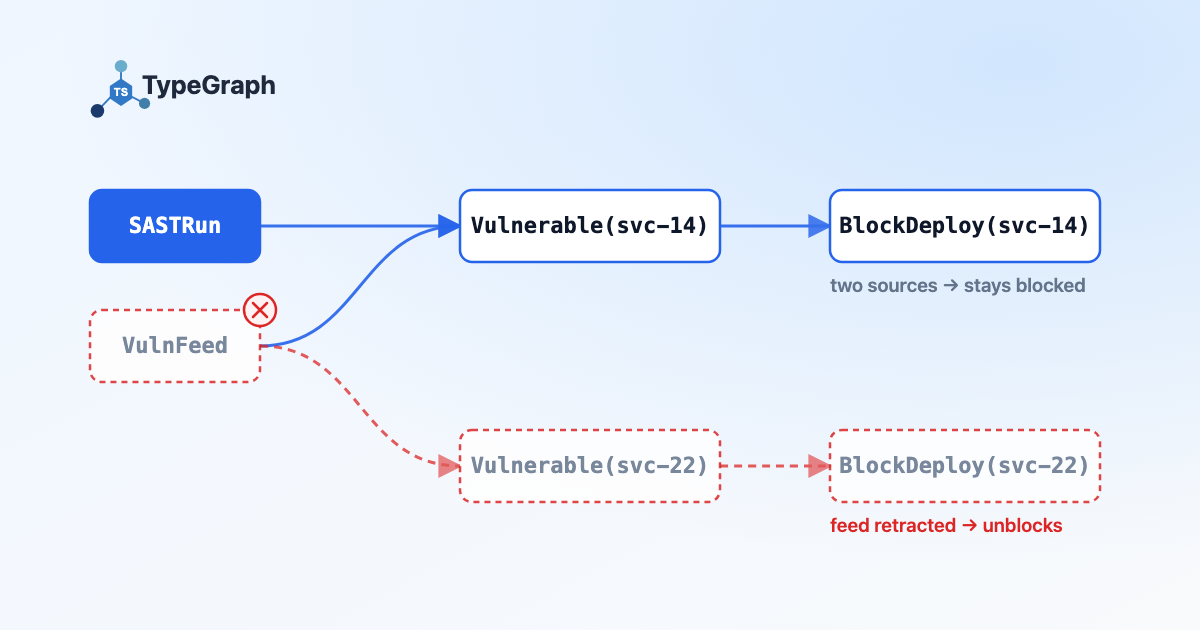
VulnFeed ──▶ Vulnerable(svc-14) ──▶ BlockDeploy(svc-14)SASTRun  ──▶ Vulnerable(svc-14)          two sources, survives
VulnFeed ──▶ Vulnerable(svc-22) ──▶ BlockDeploy(svc-22)                                         feed only, dies
Retract the feed and Vulnerable(svc-22) loses its only source, so it goes
non-current. That takes away the premise of BlockDeploy(svc-22), which goes
non-current too, and the deploy unblocks. Vulnerable(svc-14) survives
because the SAST run still backs it, so that block stands.
const report = await provenance.retract({  kind: "VulnFeed",  id: badMappingSnapshotId,});
// report.died://   flags and deploy blocks that had only the feed behind them//// report.survivedVia://   flags still confirmed by SAST or the SBOM check
Run that across all 60 services and report is your cleanup list: died
tells you which deploys to unblock and which PRs to close, and survivedVia
tells you which flags are still real. I wouldn’t trust anyone to work that out
by hand at 7am.
The source doesn’t have to be a feed; it can be another agent’s run. If a triage agent combined an overnight feed-ingest run, a SAST scan, and an SBOM rebuild into block-and-page decisions, and the feed-ingest run turns out to have trusted bad data, you retract that run, not the whole fleet’s memory:
const report = await provenance.retract({ kind: "AgentRun", id: overnightFeedRunId,});Flags raised only by that run go non-current, while flags another run also supports survive, so one agent’s mistake gets cleaned up without disturbing what the others established.
How retraction works
Section titled “How retraction works”The @nicia-ai/typegraph/provenance subpath maps your existing graph kinds
onto four roles (sources, justifications, facts, and the edges between them)
and gives you a retract that recomputes support instead of deleting
blindly:
import { createRetractionCapability } from "@nicia-ai/typegraph/provenance";
const provenance = createRetractionCapability(store, {  source: { kinds: ["ScannerSource", "VendorSource"] },  justification: { kind: "Justification" },  fact: { kinds: ["Vulnerability", "DeployDecision"] },  premiseOf: { kind: "premiseOf" },  derives: { kind: "derives" },});
A fact stays believed while at least one of its justifications has all its premises still supported. Premises bottom out at sources. Retract a source and every justification that leaned on it stops counting; a fact loses currency only when it runs out of surviving justifications.
Two properties make this safe to use. Retraction is scoped, touching
only facts reachable from the sources that flipped, and it’s reversible:
it changes whether a fact is believed without deleting anything, and the
fact’s edges stay put, so unRetract is an exact inverse of retract.
None of this is new theory. The storage follows the JTMS shape from Doyle’s
1979 A Truth Maintenance System: AND-justifications over premises, sources
as the base case, a fact believed only if some justification has all its premises supported. The
question retract answers (which facts keep support after a source drops
out) is the ATMS question from de Kleer’s 1986 work, and all of it runs on ordinary
SQL. It covers the well-founded, monotonic part of classic truth maintenance
rather than all of it. The new part is where it lives: your agent keeps
writing ordinary graph data and gets retraction semantics without moving to a
dedicated reasoning engine.
Replaying what the agent believed
Section titled “Replaying what the agent believed”Retraction is much more useful with history. You want “why did the agent block svc-22 at 2am, and why doesn’t it anymore?” to be a query rather than a dig through logs, and recorded time is what makes that possible.
TypeGraph already had valid time: when a fact was true in the world, set
with validFrom / validTo and read with store.asOf(T). 0.33 adds the
second axis, recorded time: when TypeGraph captured a fact, what the
system knew as of a commit. It’s the SQL:2011 FOR SYSTEM_TIME axis, or
Datomic’s system time. Turn it on per store:
const store = createStore(graph, backend, { history: true });Writes through that store are captured with a per-graph, monotonic commit
anchor. store.asOfRecorded(T) gives you a read-only view of the graph as
of that anchor, and store.recordedNow() hands you the current one. The two
axes compose:
store.asOf(validTime).asOfRecorded(recordedTime);Retraction is a normal write under history: true, so the whole before and
after replays:
const before = await store.recordedNow();
await provenance.retract({  kind: "VulnFeed",  id: badMappingSnapshotId,});
const after = await store.recordedNow();
await store.asOfRecorded(before).nodes.BlockDeploy.getById("svc-22"); // currentawait store.asOfRecorded(after).nodes.BlockDeploy.getById("svc-22"); // non-current
One naming note, since it trips up people coming from other systems:
TypeGraph’s asOf is valid time, the reverse of SQL:2011’s
FOR SYSTEM_TIME AS OF and Datomic’s d/as-of, where a bare “as of” means
system time. Valid-time reads are the common case here, so they got the
short name.
Why plain SQL, and what it costs
Section titled “Why plain SQL, and what it costs”There’s no portable, engine-native system versioning across Postgres and SQLite. Postgres needs an extension or an application-level pattern, and SQLite has nothing. So TypeGraph stores history in its own tables and reconstructs point-in-time views in the query compiler. One implementation runs on both backends, so the same memory model works from a solo agent’s local SQLite file up to a fleet writing into shared Postgres.
That isn’t free:
- Only TypeGraph-managed writes are captured. Raw
tx.sqlis disabled on a history store, since it would bypass capture. This is an audit layer for graph writes, not database-level CDC. - No backfill. Enable history on a fresh graph. An entity that already existed is first recorded the next time it’s written.
- Recorded reads are an audit and replay tool, not a hot path. They
reconstruct from history, so they’re slower than current-state reads, and
broad reads like
find,search, and vector predicates aren’t available at a past anchor because those indexes only reflect the present. - Writes cost more. Roughly 2.5–6× an uncaptured write when each write is its own transaction, dropping to about 1–1.5× when writes are batched.
Hardening it: 0.39 and 0.40
Section titled “Hardening it: 0.39 and 0.40”Once real consumers started reading this axis, two gaps showed up.
Commits in the same millisecond. 0.33 ordered commits by wall-clock timestamp alone, which breaks exactly when writes get fast. Five back-to-back writes:
commit 0 anchor: r1:0000000000000001:2026-07-21T17:59:03.914Zcommit 1 anchor: r1:0000000000000002:2026-07-21T17:59:03.914Zcommit 2 anchor: r1:0000000000000003:2026-07-21T17:59:03.915Zcommit 3 anchor: r1:0000000000000004:2026-07-21T17:59:03.915Zcommit 4 anchor: r1:0000000000000005:2026-07-21T17:59:03.915ZCommits 0 and 1 share 17:59:03.914Z. With a timestamp-only anchor, “the
graph right after commit 0 but before commit 1” doesn’t have an answer.
0.40 anchors are r1:<revision>:<timestamp>: the revision is a strict
per-graph counter, so every commit gets its own position no matter how many
share a millisecond. The timestamp is still there for display, and it never
moves backwards, even if the system clock does. A raw ISO string no longer
type-checks as an anchor, on purpose; get anchors from recordedNow().
Deployments that adopted the earlier format run migrateLegacyRecordedTime()
once before opening the upgraded store.
Walking a whole snapshot. 0.39 adds scan() to recorded collections:
bounded, deterministic pages (up to 1,000 per call) ordered by id, with a
cursor bound to the exact view it came from:
const view = store.asOfRecorded(anchor);const page1 = await view.nodes.Item.scan({ limit: 2 });const page2 = await view.nodes.Item.scan({ limit: 2, after: page1.nextCursor });Together those make “every row as of commit N, in order, one page at a time” a supported operation for a replication tap, an audit export, or a search index rebuild pinned to a point in history.
Why agent memory needs this
Section titled “Why agent memory needs this”A fact stored without provenance is organizational hearsay: the memory can’t tell you why it believes something or what should change when a source goes bad. A single chat agent can get away with that because a lot of inconsistency hides inside one transcript, but agents that share memory will read stale feeds, trust bad mappings, and inherit each other’s wrong assumptions.
Memory that gates deploys, or maintains any long-lived model of a company, needs to answer three questions: what do we believe, why do we believe it, and what changes if this source turns out to be wrong. This layer is built to answer those, and it runs on the SQL database you already have.
Try it
Section titled “Try it”- Provenance and Retraction and the Provenance Retraction example
- Bitemporal Time Travel example
- Logical revision and physical time: the anchor format and diagonal bitemporal reads
- Migrating preview recorded time
- GitHub
If you’ve mapped JTMS/ATMS-style truth maintenance onto relational storage elsewhere, or know of prior art that does, I’d like to hear about it. There’s plenty written on truth maintenance systems and not much on doing it directly on ordinary SQL tables.
Stay in the loop
Occasional updates on new features, guides, and releases. No spam.