

Merging Two Feeds That Disagree About the Same Patient
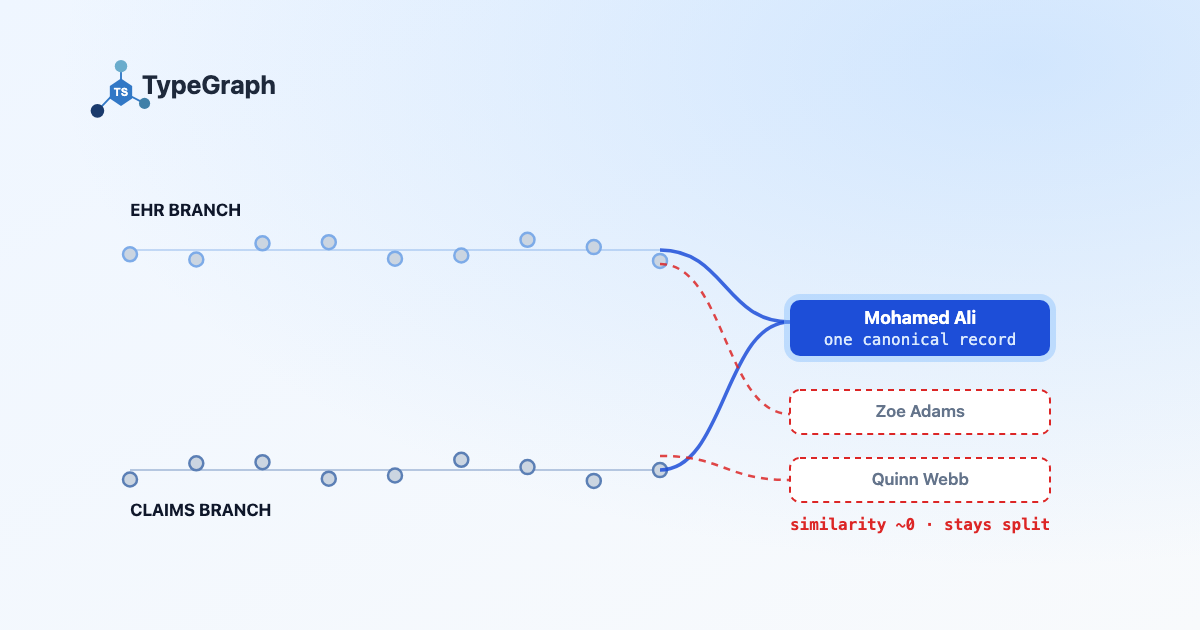
Point two ingestion agents at overlapping data (an EHR export and a claims feed, say) and tell them to “just write everything to the graph”, and you end up with two patient nodes for one person, each holding half the care history and neither aware of the other. Most pipelines then add a nightly dedupe job and hope nothing reads the graph in between.
I think append is the wrong default for graphs, which is why 0.31 ships
@nicia-ai/typegraph/graph-merge. It’s the feature I’ve been most eager to get
into people’s hands. You branch a store, let each writer work on its own copy,
and then fold the branches back in: entities are resolved, edges are repointed
onto the surviving nodes, disagreements are reported instead of silently
overwritten, and the merge records who contributed what.
Branch, write, merge
Section titled “Branch, write, merge”branch() records the base store’s current state and hands back an
isolated working copy. Writers use the ordinary store API against it.
merge() diffs every branch against the base and runs one pipeline to fold
them back in:
stage (diff every branch) → generate candidates (exact unique · blocking key · similarity) → cluster (group nodes that are the same entity) → canonicalize (pick a survivor, union properties, resolve conflicts) → repoint + dedupe edges onto survivors → reconcile delete/modify and types → commit transactionally + build the reportThe whole thing is deterministic: clusters resolve by stable keys and
conflicts are decided by an explicit branchOrder rather than by which branch
happened to arrive first, so merging the same branches in any order commits
the same graph.
Two ways to be the same patient
Section titled “Two ways to be the same patient”Example 18 runs this on a small FHIR-flavored care graph. An EHR branch and a claims branch each record the same two patients, and each gets both identities wrong in a different way:
- Anna Rivera (EHR) and Ana Rivera (claims) share
MRN-001, and becausemrnis declaredunique, they’re matched regardless of how the name is spelled, without any similarity threshold. - Mohammed Ali (EHR,
MRN-204) and Mohamed Ali (claims,MRN-205) have different MRNs, so nothing forces them together. They share a birth date, which puts them in the same blocking bucket, and they collapse because their fulltext name similarity clears the configured0.78threshold.
Landing in the same bucket only means two records get compared. The test suite also covers the other side of the threshold with Zoe Adams and Quinn Webb, who share a birth date and land in the same bucket but score near zero on name similarity, so they stay two separate patients.
const mergeOptions: MergeOptions<CareGraph> = {  resolve: {    Patient: {      block: (node) => node.birthDate,      similarity: { kind: "fulltext", fields: ["name"] },      threshold: 0.78,    },  },  onPropertyConflict: "flag",  branchOrder: [EHR_BRANCH, CLAIMS_BRANCH],  provenance: true,};
const result = await merge(base, [ehr, claims], mergeOptions);
Both pairs collapse to one canonical patient each:
merged nodes: 9merged edges: 10entity resolutions: 2That’s six nodes staged on the EHR branch plus five on claims, minus the two patients that folded into their counterparts, and all ten edges survive without duplicates.
Disagreements get flagged, not hidden
Section titled “Disagreements get flagged, not hidden”Merge doesn’t quietly pick a value when branches disagree. The properties that don’t agree are flagged, and the flags also show which identity mechanism was in play:
conflicts: - Patient.fhirId on patient-ana: claims-agent="Patient/claims-ana", ehr-agent="Patient/ehr-anna" - Patient.name on patient-ana: claims-agent="Ana Rivera", ehr-agent="Anna Rivera" - Patient.fhirId on patient-mohamed: claims-agent="Patient/claims-mohamed", ehr-agent="Patient/ehr-mohammed" - Patient.mrn on patient-mohamed: claims-agent="MRN-205", ehr-agent="MRN-204" - Patient.name on patient-mohamed: claims-agent="Mohamed Ali", ehr-agent="Mohammed Ali"There’s no mrn conflict for patient-ana, because Anna and Ana share
MRN-001 exactly. The Mohammed/Mohamed pair does flag mrn, since their
merge was based on name similarity and never required the MRNs to agree.
Every edge lands on the survivor
Section titled “Every edge lands on the survivor”This is the part I like best: everything attached to either duplicate ends
up on the one canonical patient. Here it is read back through each survivor’s
forPatient edges rather than a table scan:
Ana Rivera (MRN-001, 1974-03-09) - Encounter: Hypertension follow-up (2026-04-11T09:30:00-07:00) - Encounter: Kidney function review (2026-04-14T10:00:00-07:00) - MedicationRequest: Lisinopril 10 MG Oral Tablet - Take one tablet by mouth daily - Observation: Blood pressure panel = 152/96 mmHg (high) - Observation: Estimated glomerular filtration rate = 54 mL/min/1.73m2 (low)Mohamed Ali (MRN-205, 1990-08-21) - Encounter: Cardiology consult (2026-05-02T13:00:00-07:00) - Observation: LDL cholesterol = 168 mg/dL (high)Ana Rivera’s five resources came from both branches (the EHR encounter and medication, the claims encounter and lab result), and they now hang off a single patient node that neither branch created on its own, so anyone reading this record sees the full history. If an edge had been repointed wrongly, it would be missing from the list.
Who contributed what
Section titled “Who contributed what”With provenance: true, the merge reports which branch contributed each
committed node and edge:
provenance: - ehr-agent: 6 node(s), 6 edge(s) - claims-agent: 5 node(s), 4 edge(s)That report lives only as long as the call. Pass persistProvenance: true
and each contribution is also written as a durable
{branch, sourceId} → canonical row in a separate provenance graph on the
same backend, so “what did this provider ever contribute?” is a query you
can run next month, without adding anything to your domain schema.
Merging into a graph that kept moving
Section titled “Merging into a graph that kept moving”merge() is a snapshot operation: every branch must fork from the target’s
current state, or it fails with BaseVersionMismatchError rather than risk
clobbering newer data. That works when you fork, write, and merge in one
round, but real ingestion keeps going, and
Example 19
covers folding new batches into a target that has already moved on.
In that example a company knowledge base already has Acme Corp (acme.com),
and a provider batch reports the same company under another spelling along
with one company that’s new:
Target before: [ 'Acme Corp (acme.com)' ]Target after:  [ 'Acme Corp (acme.com)', 'Globex (globex.io)' ]
No duplicate was created: the provider's "ACME Corporation" merged onto thecommitted "Acme Corp" via the shared domain.
mergeIncremental() finds the already-committed row by its unique domain
and merges onto it instead of creating a duplicate. It’s the same mechanism
as the shared-MRN case, matched against live data instead of another branch:
const result = await mergeIncremental({ forkPoint, // the frozen ancestor the branch forked from target, // the live committed graph, which may have advanced branches: [provider], options: { resolve: { Company: { similarity: { kind: "fulltext", fields: ["name"] }, threshold: 0.9, }, }, onPropertyConflict: "flag", onBasePropertyConflict: "flag", // required: never let a stale branch value win persistProvenance: true, },});onBasePropertyConflict: "flag" is required so that a stale branch can’t
overwrite something newer than the point it forked from. If the live target
changed the same row after the fork, the target’s value wins and the
disagreement is reported.
Try it
Section titled “Try it”- Graph Merge: entity resolution, blocking, similarity strategies, conflicts, scaling guards, and determinism
- FHIR Graph Merge and Incremental Graph Merge: the docs walkthroughs
- Example 18 and Example 19: the runnable source behind this post
- GitHub
Stay in the loop
Occasional updates on new features, guides, and releases. No spam.