

An Agent That Grows Its Own Schema
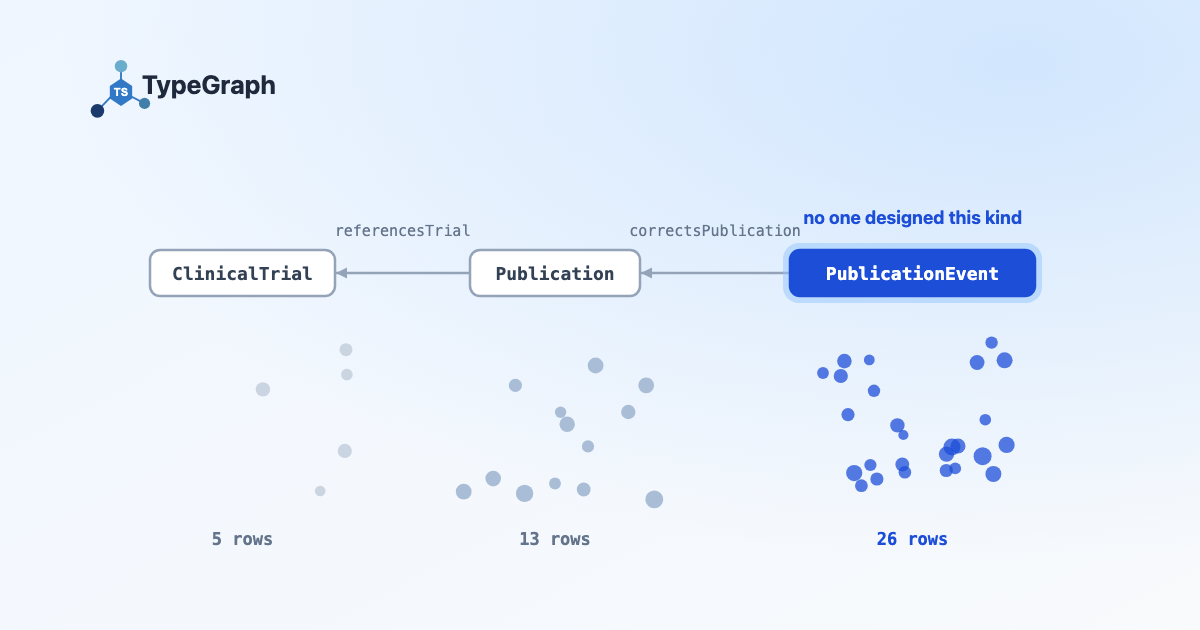
If you follow a clinical trial through the literature, you see it registered first, then published as a paper, and occasionally, years later, retracted. A retraction notice is a kind of record that wasn’t in anyone’s schema when the trial was registered, and usually wasn’t there when the paper was indexed either.
TypeGraph’s schema normally lives in code: you declare defineNode and
defineEdge in TypeScript, you get full type inference, and adding a new kind
of thing means a code change and a deploy. I think that’s the right default and
I’m keeping it, but it doesn’t fit an ingestion pipeline pulling from an API you
don’t control, a multi-tenant app where each tenant brings its own shape, or an
agent that discovers a new kind of record halfway through a corpus.
0.25 adds graph extensions for those cases. A schema change can be proposed at runtime, validated as strictly as the compile-time path, and committed atomically without a redeploy.
Proposing a change
Section titled “Proposing a change”An extension is a plain JSON document (new node and edge kinds, their property
types, unique constraints, indexes) built with defineGraphExtension and
committed with store.evolve():
const proposal = defineGraphExtension({  nodes: {    Paper: {      properties: {        title: { type: "string", minLength: 1 },        doi: { type: "string", minLength: 1 },        year: { type: "number", int: true, min: 1900, max: 2100 },      },      unique: [{ name: "paper_doi_unique", fields: ["doi"] }],    },  },});
const evolved = await store.evolve(proposal);
The type vocabulary is small on purpose: strings, numbers, booleans, enums,
and one level of array/object nesting. An LLM-written schema stays readable,
and it can’t smuggle in a Zod refinement or a function. A malformed proposal
throws GraphExtensionValidationError with per-field issues before anything
touches the database. The commit is checked against the active schema version,
so two writers racing to extend the same graph get a StaleVersionError to
retry on, not a silent overwrite.
Reads get the same care. TypeScript can’t see a kind that didn’t exist at compile time, so runtime kinds go through string-keyed versions of the query builder, which check kind names against the live schema:
const rows = await store .query() .fromDynamic("Paper", "p") .traverseDynamic("authoredBy", "a") .toDynamic("Author", "u") .select((ctx) => ({ paper: ctx.p, author: ctx.u })) .execute();A typo in a kind name throws KindNotFoundError, where a schemaless store
would quietly return zero rows and leave you to find out later.
Letting an agent drive
Section titled “Letting an agent drive”A toy example is fine for the API, but I wanted to know whether the loop holds
up against messy, real, multi-stage data. So I built
typegraph-clinical-demo:
the same machinery end to end, over real trial registrations from
ClinicalTrials.gov, their publications from PubMed, and retractions and
corrections from CrossRef. It’s all public bibliographic metadata, with no
patient data.
An LLM agent watches the corpus arrive in three stages and proposes an extension after each one. The proposals are blind: the agent sees sample records and the names of kinds already in the graph, and I didn’t give it any hints about types, searchable fields, or which identifier should be unique. Property types, optionality, searchability, and constraints are all inferred from the samples.
- Stage 1, registration. The agent sees about 1,100 ClinicalTrials.gov
records and proposes
ClinicalTrial. - Stage 2, publication. PubMed records referencing those trials arrive, and
the agent proposes
Publicationwith areferencesTrialedge back to stage 1. - Stage 3, retraction. Retraction notices and corrections arrive. Nobody
designs for these up front, because most trials never get one. The agent
proposes
PublicationEventwith acorrectsPublicationedge back to stage 2.
Each stage is a real store.evolve() against a real store, followed by a bulk
ingest under the new schema.
When the proposal is valid but wrong
Section titled “When the proposal is valid but wrong”Validation catches malformed proposals, but it can’t catch one that’s
internally consistent and still wrong for the data, like a field the agent marked
required because the three samples it saw all happened to have it. So after
each accepted proposal the demo runs a smoke test: ingest the full sample
into a scratch store seeded with every earlier extension. Failures go back to
the agent in the same structured {path, code, message} form validation uses.
Stage 3 is where it fires, on a real run:
STAGE 3: post-publication discourse agent attempt=1 validator ACCEPTED +nodes=[PublicationEvent] +edges=[correctsPublication] smoke test FAILED 2 issue(s) — proposal validates but doesn't fit the data: [INGEST_INVALID_TYPE] artifactDoi: expected string, received undefined [INGEST_INVALID_TYPE] date: expected string, received undefined agent attempt=2 validator ACCEPTED +nodes=[PublicationEvent] +edges=[correctsPublication] smoke test PASSED schema fits the sample PublicationEvent nodes: 922/922 ingested (0 skipped)The first proposal saw three samples, all correction events with
artifactDoi and date filled in, and made both required. The full-sample
ingest hit comment events without them and failed. On attempt 2 the agent
made both optional, the smoke test passed, and the graph committed. The whole
stage, repair included, takes about 16 seconds and one extra model call.
I love watching this loop work. Nobody explained the mistake to the model in prose; it got the same machine-readable errors a developer would have seen and fixed its own schema. Because the smoke test runs against a scratch store, a failed attempt leaves no stray rows or half-claimed unique keys for the next attempt to trip over. Only a proposal that survives gets committed to the real store.
The payoff
Section titled “The payoff”After stage 3 the graph has three kinds and two edges that didn’t exist when the demo started, and one query walks all of them:
const rows = await store .query() .fromDynamic("PublicationEvent", "event") .traverseDynamic("correctsPublication", "correction") .toDynamic("Publication", "pub") .traverseDynamic("referencesTrial", "reference") .toDynamic("ClinicalTrial", "trial") .select((ctx) => ({ event: ctx.event, publication: ctx.pub, trial: ctx.trial, })) .execute();On the real corpus it surfaces four documented retraction chains, including
SCIPIO (cardiac stem cells, Lancet 2011, retracted 2019) and a 2018 nilotinib
trial outcome, plus three more the corpus turned up on its own: the Anil Potti
genomic-predictor case and the Mehra et al. hydroxychloroquine retraction that
halted multiple registered trials in 2020 among them. Getting there took no
migrations, just three store.evolve() calls and a query written against kind
names that were plain strings until the agent defined them.
You don’t need a frontier model for this
Section titled “You don’t need a frontier model for this”The demo includes an eval harness (pnpm eval) that runs the same blind
three-stage pipeline across a lineup of models and scores whether each first
proposal survives validation and the smoke test. The cheapest model that
cleared all three stages on the first try was a 26B-parameter open-weight MoE
with 4B active parameters. It came in 4x cheaper than Gemini 3.1 Flash Lite
(which also went three for three) and 5x cheaper than GPT 5.4 nano (which
needed one repair).
The full three-stage run, repair included, takes under 30 seconds and costs about $0.003 in API calls. The loop needs a structured error channel and a model that can read a JSON Schema error and try again, and when the schema layer does its job, a small model handles that fine.
Try it
Section titled “Try it”- Graph Extensions: the full reference
- Agent-Driven Schema: a minimal, in-repo version of the same loop
pdlug/typegraph-clinical-demo: clone it,pnpm demo, and watch the schema grow- GitHub
Stay in the loop
Occasional updates on new features, guides, and releases. No spam.