

Introducing TypeGraph
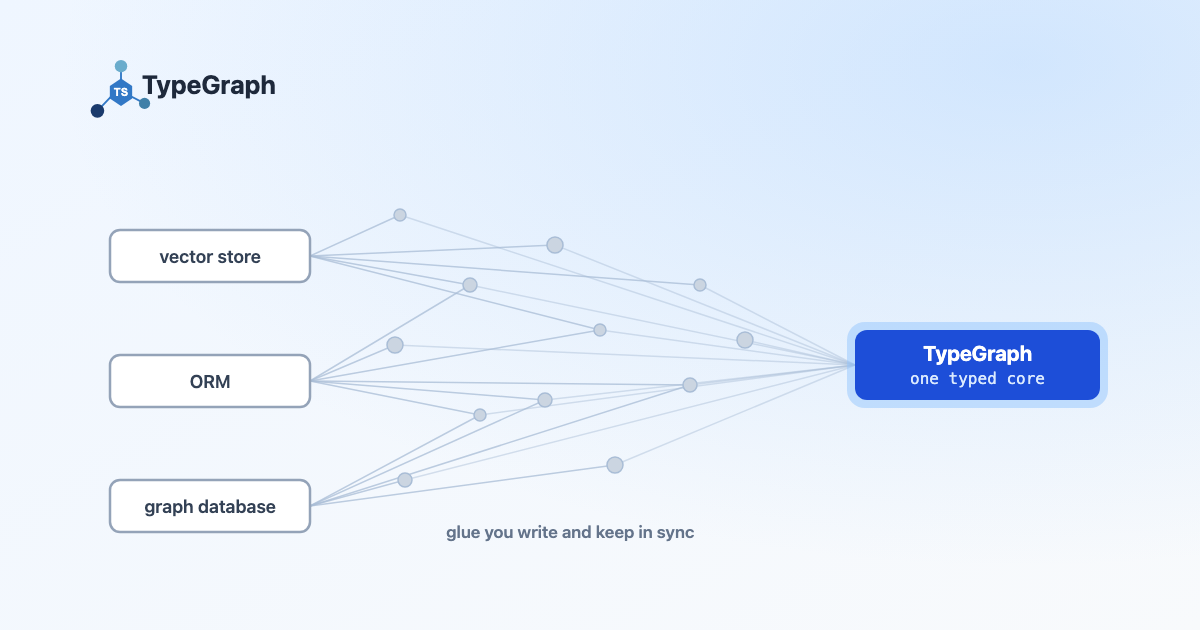
Every project I’ve worked on that needed real structure (a knowledge base, an org chart, memory for an agent) ended up with the same stack: an ORM for the actual data, a vector store added when someone wanted semantic search, and eventually, once the relationships got interesting, a graph database off to the side with a sync job keeping it roughly in line with the other two.
Each of those systems has its own idea of what a Person is and its own
consistency model, so the schema drifts between them. Meanwhile TypeScript
already has Zod, a schema language good enough to describe all of it, and none
of those systems treats it as the source of truth.
TypeGraph is the other option: keep the graph inside the application, as a library, and store it in the database you already run.
It runs in your process
Section titled “It runs in your process”TypeGraph writes through your existing SQLite or Postgres connection and commits in the same transaction as the rest of your data. You don’t deploy a graph server or keep one running, and your app doesn’t make a network hop to reach its own graph.
One schema
Section titled “One schema”You describe your data once, in Zod:
const Person = defineNode("Person", {  schema: z.object({ name: z.string(), role: z.string() }),});
const worksOn = defineEdge("worksOn", {  schema: z.object({ since: z.string() }),});
const graph = defineGraph({  id: "org",  nodes: { Person: { type: Person } },  edges: { worksOn: { type: worksOn, from: [Person], to: [Person] } },});
From that one definition TypeGraph derives runtime validation, the TypeScript types, the storage layout, and what the query builder will let you write. If you’ve ever kept an ORM schema, a folder of hand-written interfaces, and a Cypher cheat sheet in sync by hand, you know why I wanted this.
Relationships that mean something
Section titled “Relationships that mean something”A foreign key tells you two rows are related, but it can’t tell you that a
Podcast is a kind of Media, that marriedTo implies knows, or that a
Person and an Organization can never be the same thing. In most codebases
those rules live in a comment, or in the head of whoever wrote the migration.
In TypeGraph, edges are first-class and typed, and they carry their own
properties. The ontology layer (subClassOf, implies, disjointWith,
equivalentTo) does real work: a query for Media can include podcasts, a
knows traversal can pick up spouses, and a write that would make a person
and an organization share an identity fails. Traversals compile to SQL, so a
three-hop walk is one query rather than a loop of lookups.
Vectors are just another field
Section titled “Vectors are just another field”Embeddings are a field type. When you declare one, TypeGraph stores and indexes it on whichever backend you’re running:
const Document = defineNode("Document", {  schema: z.object({ title: z.string(), embedding: embedding(1536) }),});
const similar = await store  .query()  .from("Document", "d")  .whereNode("d", (d) => d.embedding.similarTo(queryVector, 10))  .select((ctx) => ctx.d)  .execute();
.similarTo() is a predicate like any other, so it composes with filters and
traversals in the same query. You don’t ask a vector database for a list of
IDs and then run a second query to find out what those IDs are.
What it isn’t
Section titled “What it isn’t”TypeGraph isn’t trying to be Neo4j. There’s no PageRank, no community detection, no distributed storage, and at this stage no traversal algorithms beyond the queries you write yourself. It’s built for thousands to millions of nodes living next to the rest of your data. If your graph is the product and it has billions of edges, you want a dedicated graph database.
Where it stands
Section titled “Where it stands”It’s early, a handful of releases in. The DSL, the ontology layer, vector search, and both backends are solid. What comes next depends on what people build with it, so if you try it and hit a wall, open an issue.
Try it
Section titled “Try it”- What is TypeGraph? and the Quick Start
- Ontology & Reasoning:
subClassOf,implies,disjointWith,equivalentTo - Semantic Search
- GitHub
Stay in the loop
Occasional updates on new features, guides, and releases. No spam.