

Embeddings Can't Find a SKU
Type PROD-1005-E into a search box and you expect one result: the product
with that SKU. Vector search is bad at this in a way tuning won’t fix: a rare
alphanumeric code barely moves an embedding, so cosine similarity ranks on
everything else in the query, and the product whose exact code you typed
ends up under a pile of vaguely similar ones.
BM25 handles it easily, because it counts terms and a token that appears in exactly one document wins however odd it looks. Rather than trying to make embeddings better at exact matches, I wanted both signals fused in one place, so 0.21 added native fulltext search and hybrid retrieval that combines it with vector search, and 0.24 finished the job on SQLite.
Fulltext is a field modifier
Section titled “Fulltext is a field modifier”Mark a field searchable() and TypeGraph keeps a BM25 index in sync on every
write. On Postgres that’s tsvector + GIN; on SQLite it’s FTS5. You don’t
need an Elasticsearch cluster for this, or a sync job to feed one.
const Product = defineNode("Product", { schema: z.object({ name: searchable({ language: "english" }), description: searchable({ language: "english" }), sku: searchable({ language: "english" }), category: z.enum(["outerwear", "footwear", "accessories", "climbing"]), embedding: embedding(16).optional(), }),});Query it with store.search.fulltext(), or use $fulltext.matches() as a
predicate inside an ordinary query, where it combines with metadata filters
and traversals in the same SQL statement:
const activeOuterwear = await store .query() .from("Product", "p") .whereNode("p", (p) => p.$fulltext .matches("lightweight", 10) .and(p.status.eq("active")) .and(p.category.eq("outerwear")), ) .select((ctx) => ({ sku: ctx.p.sku, name: ctx.p.name })) .execute();Hybrid, fused with RRF
Section titled “Hybrid, fused with RRF”store.search.hybrid() runs the vector search and the fulltext search and
merges them with Reciprocal Rank Fusion. RRF only looks at rank positions, so
it doesn’t care that a cosine score and a BM25 score live on completely
different scales, which makes it the least fiddly fusion method I know of.
const hybridHits = await store.search.hybrid("Product", { limit: 5, vector: { fieldPath: "embedding", queryEmbedding, metric: "cosine", k: 20 }, fulltext: { query: "waterproof shell", k: 20, includeSnippets: true }, fusion: { method: "rrf", k: 60, weights: { vector: 1, fulltext: 1.25 } },});Fulltext worked on both backends from 0.21, but hybrid needs the backend to
run a vector search, which SQLite couldn’t do yet, so on SQLite the hybrid call
threw ConfigurationError. 0.24 gives SQLite a real vector search on top of
sqlite-vec, built to the same shape as the Postgres version, and the hybrid
call now takes the same options and returns the same results on both.
SQLite also turned out to be the faster of the two. On the project’s search benchmark (500 documents, 384 dimensions), SQLite hybrid runs in 0.8ms against Postgres’s 2.5ms, partly because SQLite runs in-process and doesn’t pay for a round trip.
Running it
Section titled “Running it”Example 15
seeds nine outdoor-gear products (parkas, shells, a climbing harness, ski
goggles), each with a searchable name, description, and SKU, plus a small
embedding. A BM25 query for "waterproof jacket" finds the Expedition Parka,
and the snippet shows why:
Heavily insulated <mark>jacket</mark> for alpine expeditions and extremecold. <mark>Waterproof</mark> outer shell with down fill.Then the SKU:
Query: "PROD-1005-E" (looking up an exact SKU) 1. [PROD-1005-E] Climbing Harness Pro score=1.6328It comes back as the only result, where a pure vector search on that string ranks unrelated products higher because the SKU barely registers in the embedding.
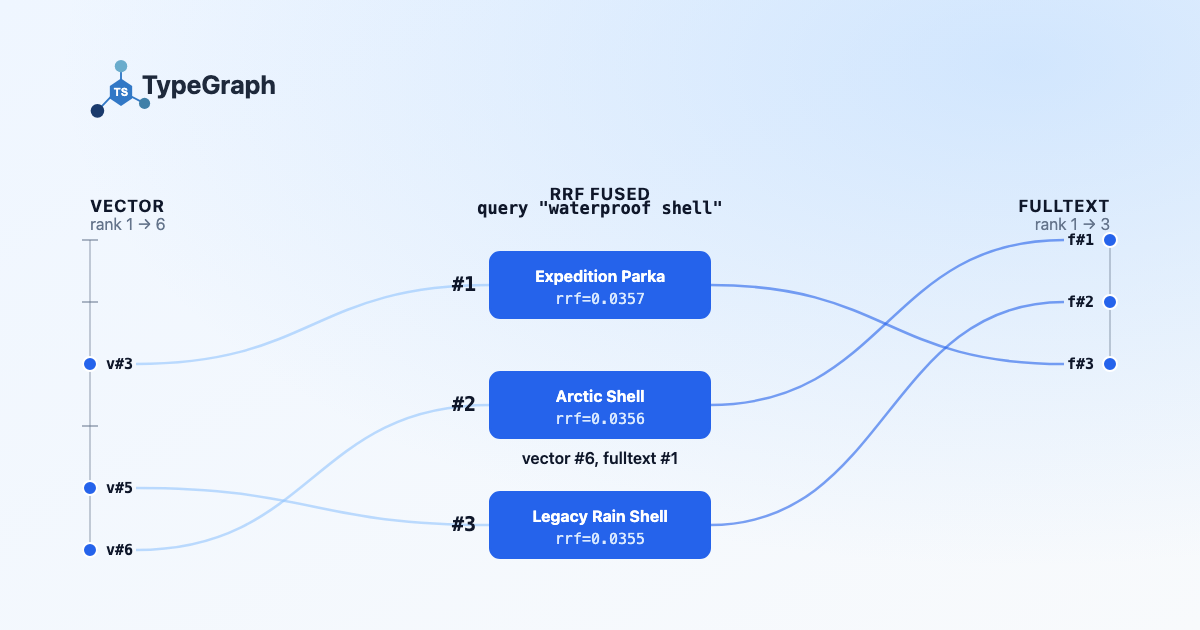
Hybrid is where it gets interesting. Here’s "waterproof shell" with k=20 on
each side, RRF k=60, and fulltext weighted at 1.25:
1. [PROD-1001-A] Expedition Parka score=0.0357 (v#3, f#3) 2. [PROD-1002-B] Arctic Shell score=0.0356 (v#6, f#1) 3. [PROD-9901-Z] Legacy Rain Shell score=0.0355 (v#5, f#2) 4. [PROD-1007-G] Compression Socks score=0.0164 (v#1, f—) 5. [PROD-1008-H] Hiking Daypack 25L score=0.0161 (v#2, f—)The (v#, f#) tags are each hit’s rank on each side. Arctic Shell was
fulltext’s top pick but only sixth by vector, so pure vector search would have
buried it, and RRF lifts it to second because doing well on either side
counts. Compression Socks went the other way: they were the vector side’s top
hit, but with no fulltext match at all they end up at the bottom of the list.
It composes with everything else
Section titled “It composes with everything else”The same fusion is on the query builder as .fuseWith(), so a hybrid search
can carry ordinary predicates. Filtering to status = "active" drops the
discontinued Legacy Rain Shell in the same query, without a post-filter:
const builderHybrid = await store  .query()  .from("Product", "p")  .whereNode("p", (p) =>    p.$fulltext      .matches("waterproof shell", 20)      .and(p.embedding.similarTo(queryEmbedding, 20))      .and(p.status.eq("active")),  )  .fuseWith({ k: 60, weights: { vector: 1, fulltext: 1.25 } })  .select((ctx) => ({ sku: ctx.p.sku, name: ctx.p.name }))  .limit(5)  .execute();
// → Arctic Shell, Expedition Parka, Hiking Daypack 25L, Ski Goggles UV400,//   Compression Socks
There are four query modes for what a search box actually receives:
websearch for Google-style syntax ("ski goggles" -compression), phrase
for exact adjacency, plain for all-terms-must-match, and raw when you want
the engine’s native tsquery or FTS5 MATCH syntax.
And if the index falls behind (you added a searchable() field, or a bulk
write went around the store), store.search.rebuildFulltext() backfills it
page by page:
Before rebuild: "waterproof" → 0 hits (fulltext rows cleared).Rebuilt: kinds=Product processed=9 upserted=9 cleared=0 skipped=0After rebuild: "waterproof" → 3 hits restored.Try it
Section titled “Try it”- Fulltext Search: RRF tuning, adding fulltext to existing data, and alternate Postgres strategies (pg_trgm, ParadeDB, pgroonga)
- Semantic Search: the vector half
- Example 15: the runnable source behind this post
- GitHub
Stay in the loop
Occasional updates on new features, guides, and releases. No spam.