

Tracking Which Records Are the Same Person
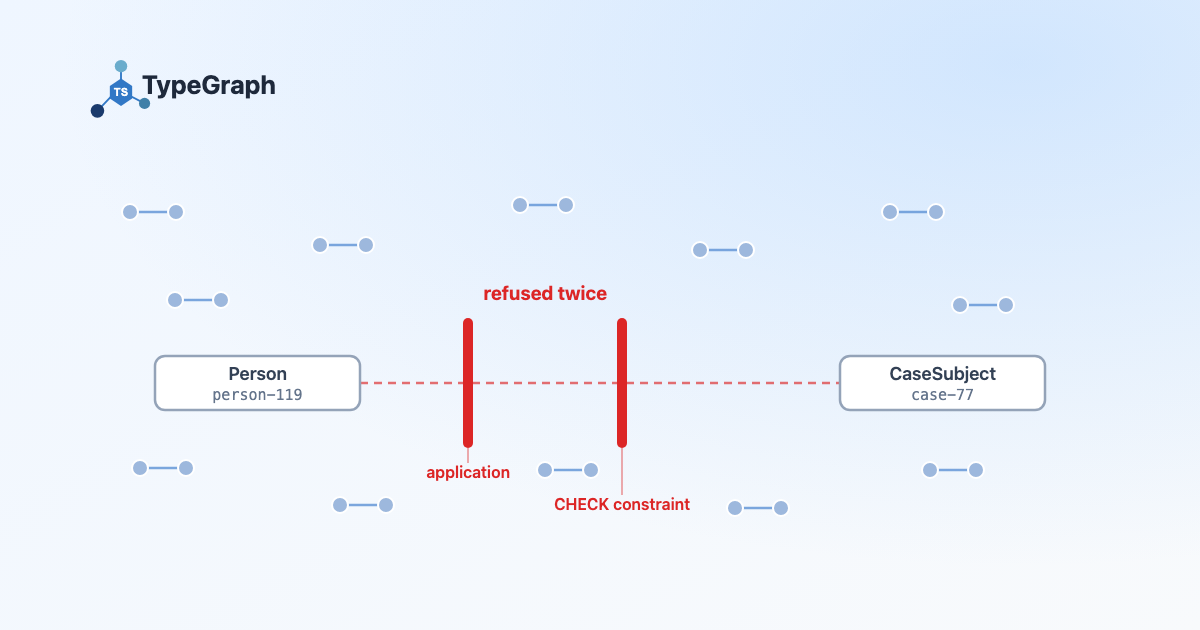
Say a bank’s KYC onboarding writes a Person node for each customer, keyed by
the bank’s customer id, and its fraud pipeline writes a CaseSubject for
everyone named in an investigation. When the person under investigation is a
walk-in customer, the case system reuses the bank’s id, so one human being
ends up as two nodes of different kinds, and nothing in the graph says they’re
the same person.
Most graph libraries handle “these are the same thing” at the type level, and
TypeGraph used to as well. The sameAs and differentFrom ontology factories
related kinds rather than rows, and differentFrom never checked anything
about actual data, which is of no use when a compliance team needs to say that
this particular customer is that particular case subject. Both factories are
deprecated now.
Their replacement, store.identity, is one of my favorite things in the
library. It’s a ledger of claims about individual nodes, either that two of
them are the same entity or that they’re provably not. You can query it at any
point in time and retract a claim without deleting it, the claims carry
through traversals and merges, and the database itself won’t commit a set of
claims that contradicts itself.
Folding on a shared id
Section titled “Folding on a shared id”Identity is opt-in per graph. Turning it on also decides what happens when nodes of different kinds share an id:
const graph = defineGraph({ id: "compliance", nodes: { Person: { type: Person }, CaseSubject: { type: CaseSubject }, Organization: { type: Organization }, }, edges: {}, ontology: [disjointWith(Person, Organization)], identity: { sameIdAcrossKinds: "fold" },});With "fold", live nodes of different kinds that share an id are the same
entity automatically. ("ignore" gives you the ledger without that implicit
join, for graphs where a shared id is a coincidence.) The two systems above
never have to coordinate:
const person = await store.nodes.Person.create(  { name: "Alex Rivera" },  { id: "cust-8842" },);const subject = await store.nodes.CaseSubject.create(  { note: "Named in fraud case FC-2201" },  { id: "cust-8842" },);
await store.identity.membersOf(person);// [{ kind: "CaseSubject", id: "cust-8842" },//  { kind: "Person", id: "cust-8842" }]
A fold starts when the node actually exists, not at its validFrom. A node
created today with a backdated validity window shows up in historical reads,
but it doesn’t retroactively fold anything in the past.
Saying it explicitly
Section titled “Saying it explicitly”Most matches don’t come with a shared id. Here an investigator links a walk-in customer to an actor in an unrelated case, under two ids that have nothing in common:
const walkIn = await store.nodes.Person.create(  { name: "J. Alvarez" },  { id: "person-119" },);const caseActor = await store.nodes.CaseSubject.create(  { note: "Signed the wire authorization in case FC-2214" },  { id: "case-77" },);
const linked = await store.identity.assertSame(walkIn, caseActor);// { action: "created", assertion: { id, relation: "same", a, b, validFrom } }
await store.identity.assertSame(walkIn, caseActor);// { action: "existing", assertion: <same assertion> } — idempotent
Asserting the same thing twice gives you the existing assertion back, so a
job that re-runs after a crash doesn’t need to know whether it got that far
last time. There are bulk forms (bulkAssertSame, bulkAssertDifferent) that
return one result per input pair, in order.
Claims are also checked against the ontology before anything is stored.
Since Person is disjointWith Organization, folding the walk-in onto a
company fails:
await store.identity.assertSame(walkIn, acmeFreight);// throws IdentityContradictionError// details: { operation: "assertSame", reason: "disjoint-kinds", a, b }Claims can also be bounded in time. A merged account that was later split, or a case subject that was only correct for the window an investigation covered, gets a half-open validity window:
await store.identity.assertSame(alice, legacyAlice, { validFrom: "2020-01-01T00:00:00.000Z", validTo: "2022-01-01T00:00:00.000Z",});Both endpoints have to exist for the whole window, and contradictions are
checked across every overlapping stretch of time, including through chains of
same claims.
Changing your mind
Section titled “Changing your mind”Suppose forensic review later shows that person-119 and case-77 are two
different people who happened to share a wire-authorization signature. You
want to record that, but the ledger currently says they’re the same entity,
and it won’t hold both claims at once:
await store.identity.assertDifferent(walkIn, caseActor);// throws IdentityContradictionError// details: { operation: "assertDifferent", reason: "same-class", a, b }You retract the old claim first, explicitly:
const ended = await store.identity.retractAssertion(linked.assertion.id);// ended.validTo: "2026-08-21T18:03:11.442Z" — the fold ends, timestamped
await store.identity.assertDifferent(walkIn, caseActor);// { action: "created", ... } — now recorded as provably different
await store.identity.areSame(walkIn, caseActor); // falseawait store.identity.areDifferent(walkIn, caseActor); // true
Nothing was deleted: the retracted assertion and its validTo are still
readable, and a query at a time before the retraction still sees one entity,
so if an auditor asks why these two records were treated as one customer in
August, you can answer them.
Soft-deleting a node ends its current assertions too, and records the node as
the reason (endedBy), so a later reader can tell why a claim ended.
A backstop in the database
Section titled “A backstop in the database”Everything so far is application code deciding whether a write is allowed,
and application code can be wrong. assertSame checks against state it just
read, so a bug somewhere else that writes identity rows directly could still
commit the contradiction the API rejects.
So identity also keeps a table of which identity classes are held apart by a
different claim, with a database CHECK constraint on it. When a
transaction merges two classes, it rewrites those rows in the same batch. If
two classes that are supposed to be separate get merged anyway, the rewrite
violates the constraint and the database aborts the transaction:
// IdentitySeparationViolationError// details: { graphId, enforcedBy: "database", classKey,// assertionId, a, b }The API catches contradictions first and gives you a useful error, and the constraint is there for the case where the API has a bug.
Traversals that understand it
Section titled “Traversals that understand it”Queries can expand through identity classes, per hop, and it’s off by default:
const results = await store .query() .from("Person", "person") .traverse("authored", "edge", { includeIdentityMembers: true }) .to("Document", "document") .select((ctx) => ({ edge: ctx.edge, document: ctx.document })) .execute();That hop follows authored edges from the person and from every other node
in their identity class, and returns the real edge and target rows with
duplicates removed.
At the current time, each hop looks classes up through an index on the
maintained closure, so the cost tracks the rows you start from and the size of
their classes, not how many classes the graph holds. Measured on SQLite, with
each Person folded to a Company and an Alias sharing its id, before and
after the closure became index-seekable:
| source rows | fan-out | matching edges | before | after |
|---|---|---|---|---|
| 250 | 1 | 250 | 67 ms | 6 ms |
| 1000 | 1 | 1000 | 1077 ms | 9 ms |
| 2000 | 1 | 2000 | 4616 ms | 19 ms |
| 1000 | 8 | 8000 | 8611 ms | 13 ms |
| 500 | 200 | 100,000 | 51,602 ms | 77 ms |
That closure only describes the present, which is worth planning around. A hop at a historical time has to rebuild classes from the assertion ledger for the whole graph, once per statement, even if you only asked about one node, so queries about the present are much cheaper than queries about the past.
Identity claims also carry through interchange and graph merge. Exports carry
assertions (current ones by default, ended ones too if you ask for an archival
export), and graph merge treats identity as part of what it diffs. Two branches
that make opposing claims about the same pair, or that contradict each other
through a chain of same claims neither wrote alone, fail at plan time with
IdentityMergeConflictError, and the merge checks again inside its own
transaction before committing.
Staging the duplicate you came to resolve
Section titled “Staging the duplicate you came to resolve”Ingestion is where identity gets messiest. Say a provider feed arrives with a
patient carrying MRN MRN-4471 and the graph already has a Patient with
that MRN. That’s expected, since deciding whether the two are the same person
is why the ingestion pass exists, but Patient declares unique("mrn"), so
the second row can’t be written. If you stage it on an ordinary branch(),
staging fails at the duplicate before entity resolution has seen anything.
ingestionBranch() makes a working copy that defers node uniqueness and
nothing else, so schema validation, endpoint checks, disjointness and edge
cardinality all still apply while staging. The usual answer to this problem is
a “skip validation” flag on the import, which I didn’t want, because it lets
every other kind of bad row in alongside the duplicates you meant to allow.
const incoming = unwrap(  await ingestionBranch(base, makeBackend, { id: asBranchId("provider-a") }),);
const imported = await importGraph(incoming, providerDocument, {  onConflict: "error",  onUnknownProperty: "error",});if (!imported.success) throw new Error("Provider import was rejected");
const alias = await incoming.nodes.Patient.getById(  asNodeId("incoming-patient"),);if (alias === undefined) throw new Error("Imported patient was not found");
// `canonicalPatient` was read from the base before forking.await incoming.identity.assertSame(canonicalPatient, alias);
The duplicate MRN and the claim that explains it now sit on the same branch and reach merge planning together. The handle only exposes the assertion methods, without identity reads, retractions, transactions, or access to the underlying store, so it can’t be used to get around the deferred constraint.
At merge time the original uniqueness rule applies again. applyMergePlan()
checks uniqueness against the entire resolved write set inside the target
transaction, so a valid key handoff or swap goes through as one set (a
row-by-row check would see two owners in the middle and reject it). If
resolution still leaves two live owners of one MRN, the merge fails with
MergeConstraintConflictError and writes nothing, so the deferral only gives
you room to review the duplicate before merging.
What it costs
Section titled “What it costs”A graph without identity enabled pays nothing: no identity SQL, locks, or closure work. With it on:
- One writer per graph for identity-affecting writes on Postgres. They serialize on a per-graph advisory lock. Other graphs and all reads are unaffected.
- First-time enablement is heavy. It briefly takes a
SHARElock on the shared nodes table, which blocks writes for every graph in that database, and loads the whole graph to build the initial closure. Do it in a quiet window. - Switching
foldandignoreis a breaking schema change, because it changes everyareSameanswer on existing data. It needs an explicit migration. - It needs real transactions. The bundled SQLite and Postgres drivers
have them. Cloudflare D1 and
drizzle-orm/neon-httpdon’t, and reject an identity-enabled graph at construction.
store.identity records and propagates the identity claims you make, so
deciding that two records are the same person is still up to you or your
entity-resolution pass. What it adds is a durable record of those decisions,
including when each was made and when it stopped being true.
Try it
Section titled “Try it”- Operational Identity: the full guide, including migrating off
sameAs/differentFrom - Constraint-aware ingestion branches
- Graph Merge: branch, resolve, and merge identity back
- GitHub
Stay in the loop
Occasional updates on new features, guides, and releases. No spam.