

Replacing the N+1 Loop With One Statement
Most apps have a page like this one: a workspace lists its published documents, and each row shows the title, how many versions the document has, the note on the newest version, and the three most recent comments. Every piece of that is a one-hop read from the document, so the first version anyone writes is a loop:
const documents = await store  .query()  .from("Document", "document")  .whereNode("document", (document) => document.status.eq("published"))  .orderBy("document", "title")  .select((ctx) => ctx.document)  .execute();
const rows = await Promise.all(  documents.map(async (document) => {    const versionEdges = await store.edges.hasVersion.findFrom(document);    const versions = await store.nodes.Version.getByIds(      versionEdges.map((edge) => edge.toId),    );    const commentEdges = await store.edges.hasComment.findFrom(document);    const comments = await store.nodes.Comment.getByIds(      commentEdges.map((edge) => edge.toId),    );    // Sort in JavaScript: newest version, version count, three latest comments.    return summarize(document, versions, comments);  }),);
Counted at the driver, that loop issues 33 statements for eight documents, one for the list and four per document. On in-memory SQLite you’d never notice, but with the database across a network every one of those is a round trip, the count grows with the length of the list, and you’re loading every comment to keep three and every version to keep one.
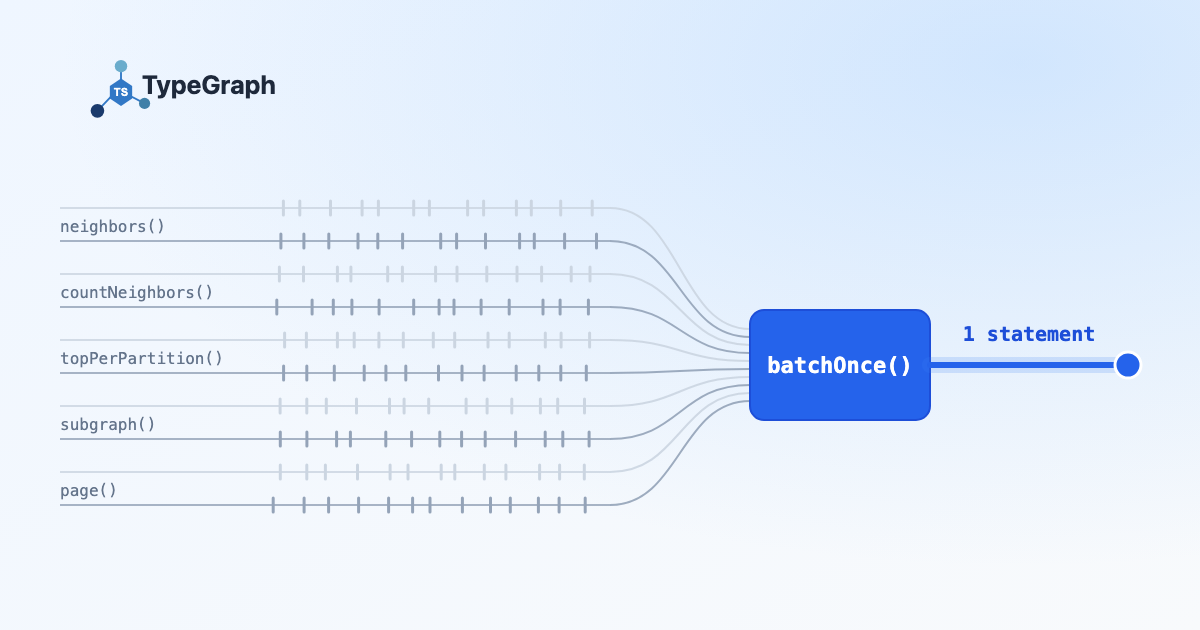
This is the N+1, the oldest performance bug in the book, and over releases 0.58 to 0.65 I went after it properly. The same page now costs one SQL statement, and when TypeGraph can’t do a batch in one statement it throws before running anything instead of quietly issuing more.
(Every number here is a statement count, measured by wrapping
better-sqlite3’s Statement and exec in the script that ran the code. None
of them are wall-clock times. What a round trip costs on your network is
yours to multiply in.)
Step one: reads that say what they want
Section titled “Step one: reads that say what they want”store.neighbors() joins each edge to the node on its far end in a single
statement, and applies ordering and the limit before hydrating anything, so
“the newest version” fetches one row. store.countNeighbors() is the matching
count and hydrates nothing at all.
const [latest] = await store.neighbors(document, { edges: ["hasVersion"], orderBy: { by: "node", field: "sequence", direction: "desc" }, limit: 1,});const versions = await store.countNeighbors(document, { edges: ["hasVersion"],});Two calls per document is 16 statements for the page, which is better than 33 but still grows with the length of the list.
Step two: batchOnce()
Section titled “Step two: batchOnce()”store.batchOnce() is the part I’m happiest with. It takes any number of
independent reads and runs them as exactly one SQL statement: each read
becomes a CTE, and a single JSON envelope carries every result set back, in
input order. The callback can return a runtime-sized array, which means the
loop above translates almost literally:
const results = await store.batchOnce((read) => documents.flatMap((document) => [ read.neighbors(document, { edges: ["hasVersion"], orderBy: { by: "node", field: "sequence", direction: "desc" }, limit: 1, }), read.countNeighbors(document, { edges: ["hasVersion"] }), ]),);// results[2 * i] is document i's newest version, results[2 * i + 1] its count.That takes the page from sixteen statements to one. Inside a transaction,
tx.batchOnce() binds to the open connection, so the batch sees writes made
earlier in the same callback and is still one statement.
It won’t quietly fall back
Section titled “It won’t quietly fall back”A lot of “batch” APIs are really a for loop, and you only find out they
issued N queries when a latency graph shows it a month later. batchOnce()
has no fallback path, so if it can’t do the job in one statement it throws
before executing anything:
await store.batchOnce((read) => Array.from({ length: 501 }, () => read.countNeighbors(document, { edges: ["hasVersion"] }), ),);// ConfigurationError: store.batchOnce() accepts at most 500 reads in one statement.Five hundred reads run as one statement, and 501 throws without issuing any.
It won’t chunk to fit the backend’s bind-parameter limit either, and reads that
can’t be embedded (edge-collection batchFind* calls, for example) are
rejected instead of being run on the side. Since the name promises one
statement, I’d rather it fail loudly than break that promise.
The older store.batch(), by contrast, runs its queries one after another. It
always did, and the docs now say so plainly because people were putting it in
hot paths expecting a single round trip.
Step three: shape it in SQL
Section titled “Step three: shape it in SQL”A batch of neighbors() calls still has one read per parent, so eight
documents means sixteen reads inside the statement, and the 500-read ceiling
works out to 250 documents. When the question is “for every document in this
result”, a relation answers it with a fixed number of reads however long the
list is.
0.61 added project(), derived relations, and aggregates; 0.63 added
topPerPartition():
const published = () =>  store    .query()    .from("Document", "document")    .whereNode("document", (document) => document.status.eq("published"));
const versions = published()  .traverse("hasVersion", "link")  .to("Version", "version")  .project((fields) => ({    documentId: fields.document.id,    versionId: fields.version.id,    sequence: fields.version.sequence,    note: fields.version.note,  }))  .asRelation();
const versionCounts = versions  .groupBy((columns) => [columns.documentId])  .aggregate((columns) => ({    documentId: columns.documentId,    versions: expr.count(columns.versionId),  }));
const latestVersions = versions.topPerPartition({  partitionBy: (columns) => [columns.documentId],  orderBy: (columns) => [    { expression: columns.sequence, direction: "desc" },    { expression: columns.versionId },  ],  limit: 1,});
topPerPartition() uses ROW_NUMBER(), so ties don’t widen the limit. Both
orderings end in an id because the API can’t know your ordering is unique,
and a repeatable winner needs a tiebreaker. The comments are the same shape
with a limit of three, plus an ordered collection that folds the winners into
one array per document:
const recentComments = published() .traverse("hasComment", "link") .to("Comment", "comment") .project((fields) => ({ documentId: fields.document.id, commentId: fields.comment.id, body: fields.comment.body, postedAt: fields.comment.postedAt, })) .asRelation() .topPerPartition({ partitionBy: (columns) => [columns.documentId], orderBy: (columns) => [ { expression: columns.postedAt, direction: "desc", nulls: "last" }, { expression: columns.commentId }, ], limit: 3, }) .groupBy((columns) => [columns.documentId]) .aggregate((columns) => ({ documentId: columns.documentId, recent: expr.collect(columns.body, { orderBy: [ { expression: columns.postedAt, direction: "desc", nulls: "last" }, { expression: columns.commentId }, ], }), }));Relations are batch members like any other read, so the whole page, titles included, is one statement:
const titles = published()  .orderBy("document", "title")  .select((ctx) => ({ id: ctx.document.id, title: ctx.document.title }));
const [documents, counts, latest, comments] = await store.batchOnce(  () => [titles, versionCounts, latestVersions, recentComments] as const,);
Joined on documentId, a row comes out as:
{ id: "1BMs3-6PEJYXtjB9BcrsU", versionCount: 3, latest: "v3 of doc 2", recent: ["comment 5 on doc 2", "comment 4 on doc 2", "comment 3 on doc 2"] }The script asserts that these eight rows are identical to what the loop produced. Here’s how the versions of the page compare:
| Page for eight documents | Statements |
|---|---|
Loop of findFrom() and getByIds() |
33 |
Loop of neighbors() and countNeighbors() |
16 |
batchOnce() of the neighbors() reads |
1 |
batchOnce() of four relations |
1 |
neighbors() fits when you already hold a handful of sources, and relations
fit when you want “every parent in this result”. topPerPartition() needs
window functions
and ordered expr.collect() needs ordered aggregates; a backend without them
throws a typed error before executing.
The rest of the set-shaped toolkit
Section titled “The rest of the set-shaped toolkit”A few smaller pieces from the same stretch, all aimed at the same habit of doing one thing per row:
-
bulkFindFrom()/bulkFindTo()arefindFrom()/findTo()for a whole page of endpoints. Indexiof the result holds the edges of inputi, an endpoint with no edges gets an empty array, andlimitPerInputcaps each endpoint’s fan-out. Fifty people’s jobs cost one statement per endpoint kind (split only when the bind-parameter budget requires it) instead of fifty.const people = await store.nodes.Person.find({ limit: 50 });const jobsPerPerson = await store.edges.worksAt.bulkFindFrom(people); -
store.bulkFindEdgesTo()does the inbound direction across several node and edge kinds at once. Twelve documents and two edge kinds was one statement; callingfindTo()per kind per document was 24. -
updateWhere()is a set-based, transactional update that returns how many rows changed. The selector is mandatory (where,exists, a candidate query, or an explicitall: true), so you can’t wipe out a whole kind by forgetting a filter:const result = await store.nodes.Person.updateWhere({patch: { active: false },where: (person) => person.lastSeen.lt(cutoff),exists: [{edgeKind: "worksAt",direction: "out",relatedKind: "Company",whereRelated: (company) =>company.field("status").string().eq("closed"),},],});// { affectedCount: number } -
in()/notIn()take list parameters, sofield.in(param("ids"))binds a runtime-sized list in a prepared query instead of forcing you to rebuild the query per call. -
Subgraphs got per-edge-kind windows (keep only the newest N edges of a noisy kind), and
subgraph()works insidebatchOnce(). Five roots awaited in a loop cost 10 statements on SQLite; batched, one. -
Mixed-kind cursor pages: a query can start from several kinds (
.from(["Person", "Team"], "entity")), and a.page()can sit in a batch next to unrelated reads, so a directory of people and teams can be read as one ordered stream at one statement per page. -
executeChecked(version)folds the “has another isolate changed the schema?” probe into the read itself, for serverless deployments that cache the schema per isolate. Probing and then reading took 2 statements, and the checked read takes 1. A moved schema throwsSchemaChangedError, even when the query would have matched no rows.
What one statement doesn’t buy you
Section titled “What one statement doesn’t buy you”- It saves round trips, but the database does the same work. Every member
of a batch still runs its own plan. For one large closure on Postgres, the
direct
subgraph()can beat the batched form, andtopPerPartition()bounds the rows returned, not necessarily the rows scanned. - Results are materialized.
batchOnce()returns JSON envelopes, doesn’t stream, and has no byte cap. Bound your reads with limits and projections. - The counts are SQLite driver counts. They show the shape of the improvement, and your actual latency depends on your network.
Try it
Section titled “Try it”store.batchOnce(): the full contract, including what can and can’t be embedded- Top-N per parent and Ordered collections
updateWhere()andbulkFindEdgesTo()- GitHub
Stay in the loop
Occasional updates on new features, guides, and releases. No spam.