

Merges That Wait
Graph Merge plans before it applies: you fork a working
copy with branch(), stage changes on it, and planMerge() shows you the exact
write set before anything touches the target. That works well as long as
staging, planning and applying all happen in one run of one process.
The workflows that most want a review step don’t look like that. Say a nightly job proposes loyalty-point adjustments that a person approves the next morning, a deploy lands in between, and the thing feeding the branch is a queue that occasionally delivers the same message twice. An in-memory branch handle and a plan that goes stale as soon as anything is written can’t cope with any of that.
It took three releases to fix, and I think the result is one of the more unusual things TypeGraph can do. 0.56 made the review itself durable by storing it as graph data, 0.67 made the working copy durable so a branch can be closed in one process and reopened in another, and 0.68 made it safe to feed that branch from an at-least-once queue.
The review lives in the graph
Section titled “The review lives in the graph”A merge plan is tied to the target’s revision, so if the target changes after planning, applying the plan fails. That rule is what keeps a stale plan from clobbering newer data, but it gets in the way if you want the review (the proposal, the decision, who approved it) stored as graph data next to the record it concerns, because writing the review down is itself a write to the target, and by the time anyone approves the plan it’s stale.
0.56 resolves this by separating what was reviewed from the plan you
eventually apply. planCandidateWriteSetReview() captures the candidate
changes, the plan, the policy, and a baseline of the target as one immutable,
content-digested artifact:
const review = unwrap( await planCandidateWriteSetReview({ target: store, makeBackend, policy: { id: "manual-acceptance-v1", context: { requiredApprovals: 1, authorizedReviewers: ["reviewer:maya"] }, }, writeSet: { formatVersion: 1, sourceId: "catalog-review", target: await captureCandidateWriteSetTarget(store), nodes: [ { kind: "Item", id: proposal.id, properties: { label: proposal.label, status: "accepted" }, }, ], edges: [], }, }),);You store it as ordinary graph data, keyed by its own digest, along with the
reviewer’s decision. Artifact, Decision and evidence here are ordinary
kinds the example defines itself, so this needs no special schema support:
const artifact = await store.nodes.Artifact.create(  { content: JSON.stringify(review) },  { id: review.digest.value },);await store.edges.evidence.create(proposal, artifact, { note: "review" });
const decision = await store.nodes.Decision.create({  approved: true,  reviewDigest: review.digest.value,  reviewer: "reviewer:maya",});await store.edges.evidence.create(decision, artifact, { note: "approval" });
Applying the original plan at this point fails:
const stale = await applyMergePlan(store, review.plan);// stale.error is a StaleMergePlanErrorRecording the review and the approval moved the target, so the plan is stale. This is the part I like: durable review doesn’t get an exemption from the staleness check, because if recording an approval could quietly un-stale a plan, the check would mean nothing.
Instead of reusing the plan, you call revalidateCandidateWriteSetReview(),
which reads the stored artifact, re-plans the retained candidate against the
current target, and tells you what it found:
checked.status |
What it means |
|---|---|
compatible |
Nothing that matters moved. You get a fresh plan and the original reviewDigest. |
changed |
Policy, options, baseline entities, or plan fields differ from what was reviewed. Get a new review and approval. |
incompatible |
Graph id, schema identity, or revision origin don’t match. This approval can’t be used against this target at all. |
In the example only the review and approval records were added, so the result
is compatible. I was careful to keep compatible meaning only that nothing
relevant moved; it says nothing about whether the caller is allowed to act, so
the example checks both before spending the plan:
if (checked.status !== "compatible") {  throw new Error("A new review and approval are required");}if (checked.reviewDigest.value !== approval.reviewDigest) {  throw new Error("Approval does not identify the validated review");}
const report = unwrap(await applyMergePlan(store, checked.plan));
Authenticating the stored decision and enforcing authorizedReviewers are
still your job. TypeGraph tells you whether the plan is safe to apply and
leaves the question of who may apply it to you.
A working copy that outlives its process
Section titled “A working copy that outlives its process”The branch itself was still tied to one process, because a branch() result
holds its store and close handle in memory and disposing it deletes the fork.
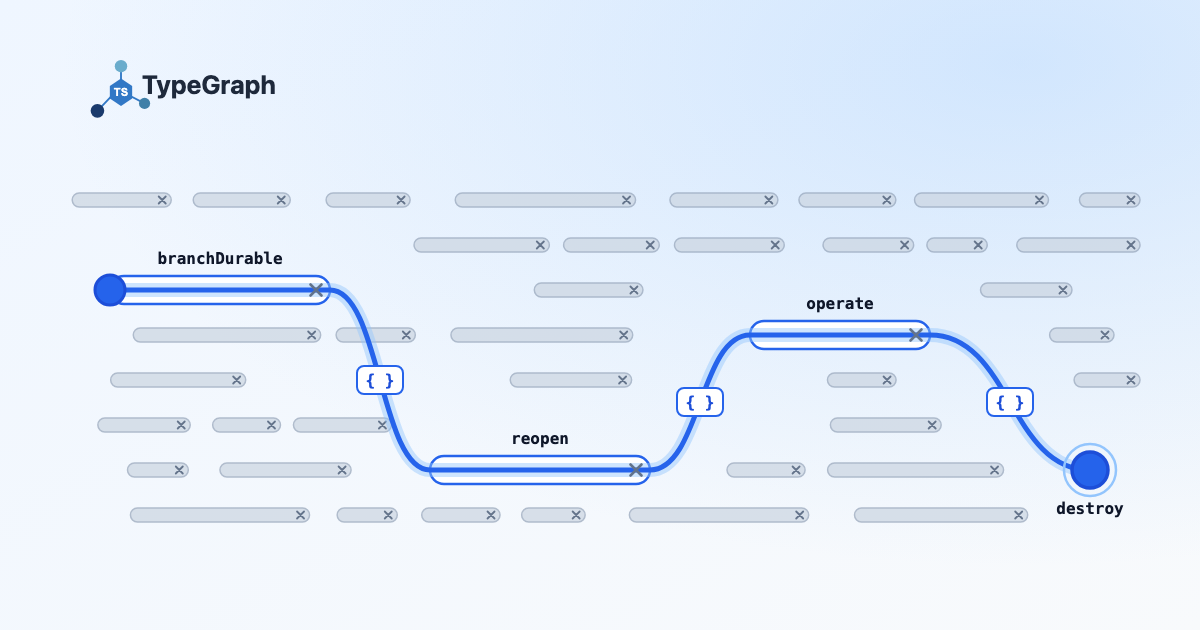
0.67 adds branchDurable(), which forks a working copy that persists and hands
back a small JSON descriptor you can put on a queue. Here’s the loyalty
ledger’s nightly job:
const created = unwrap(await branchDurable(base, host));const staged = created.branch.store;
await staged.nodes.Account.update(ada.id, { points: 160 });await staged.nodes.Account.create({ name: "Grace", points: 40 });
// Releases this process's connection and writer lease. The working copy stays.await created.branch.close();await queue.put(JSON.stringify(created.descriptor));
The descriptor is the only thing that leaves the process:
{ "kind": "sqlite-file-host", "version": 1, "graphId": "loyalty", "definitionHash": "ec9dd68d2fbf14e3", "branchId": "gluQHM58QmB1LFjZIJEdA", "base": "ec9dd68d2fbf14e3#s1\u0000revision:kHeqC6EE55ENVL3a_np2R:r1:0000000000000001:2026-09-20T19:16:21.492Z", "store": { "id": "35da40a3-1820-4b9f-b9b4-2117e653ded8" }, "schemaAnchor": { "version": 1, "hash": "ec9dd68d2fbf14e3" }}TypeGraph doesn’t ship a durable host. It defines the contract (a
DurableWorkingCopyStrategy with create, seal, reopen, abort and
destroy), and your host decides where a working copy lives, whether that’s a
directory, a database, or a provider’s branch API. The descriptor’s store
field is the host’s opaque locator, and everything else in it belongs to
TypeGraph. The examples here ran against a small file-backed SQLite host,
across separate node processes.
The next day a different process reads the descriptor and reopens the branch,
and what comes back is an ordinary GraphBranch, so everything after that is
the merge API you already know:
const descriptor = JSON.parse(await queue.get());
const branch = unwrap(await reopenDurableBranch(graph, descriptor, host));const plan = unwrap(await planMerge(base, [branch]));
const report = unwrap(  await applyDurableMergePlan({    target: base,    branch,    descriptor,    strategy: host,    plan,  }),);await branch.close();unwrap(await destroyDurableBranch(descriptor, host));
plan: 2 node upserts, 0 conflictsmerged: {"nodes":2,"edges":0,"identity":{"asserted":0,"retracted":0}}base now: Grace=40, Ada=160reopen after destroy refused: trueapplyDurableMergePlan() applies the approved plan through the target Store
transaction. The former optional host-native merge hook was retired because a
database merge that commits internally can cross the transaction boundary
that checked the target revision. A host may still use native database
branches for its durable working copies.
A descriptor is a document your application stored and handed back later, so TypeGraph treats it as untrusted input. At fork time the host seals the true origin, and every reopen and destroy is checked against it, so relabeling the branch id makes the reopen fail:
Durable branch descriptor does not match the working copy the host attested forits store locator: the descriptor's TypeGraph fences disagree with the originrecorded at fork. This is a tampered, relabeled, or wrong-branch descriptor.The same check stops you from destroying branch B with branch A’s descriptor,
or reopening with a graph that reuses the id "loyalty" but defines
Account differently.
The message that arrives twice
Section titled “The message that arrives twice”Suppose the branch is fed from a queue where “award Ada 25 points” can arrive twice. The award has to apply exactly once, and whoever is downstream (a notification, an audit log) has to hear about every applied award eventually, even if the worker dies right after committing.
What that calls for is a transactional outbox scoped to the working copy, and
0.68 builds one into the durable-branch contract. You hand
operateDurableBranch() an idempotency key, a mutation describing the
change, and metadata to keep as evidence:
const outcome = unwrap( await operateDurableBranch(descriptor, host, { idempotencyKey: "award-7731", metadata: { source: "orders-queue", messageId: 7731 }, mutation: { op: "award", account: adaId, points: 25 }, }),);TypeGraph never interprets mutation; it digests it together with metadata,
hands the host the request, and validates what comes back. The host applies
the change and writes an evidence row in one database transaction, which in
this host is a single SQLite transaction on one connection. To check the
rollback, I made it throw after the graph write and before the evidence insert:
DurableOperationError | GRAPH_MERGE_OPERATION | Durable operation failed: injected failure after the graph writeevidence: undefinedaccounts: Grace=40, Ada=160There’s no evidence row, and Ada is still at the staged 160.
In the real run, the worker commits the award (Ada goes from 160 to 185) and then dies before telling anyone. A fresh process picks up the descriptor, and the queue redelivers the same message:
recover pid 76873 | Ada on branch: 185redelivered: replayed | Ada on branch: 185replayed returns the evidence from the first run and applies nothing, so Ada
stays at 185 instead of 210. If you reuse the key with a different payload,
even just different metadata, the host rejects it without writing:
changed payload: DurableOperationConflictError | GRAPH_MERGE_OPERATION_CONFLICTAda on branch: 185The evidence rows act as the outbox. Each one starts with delivered: false,
and you can’t destroy the branch while any are undelivered:
destroy: DurableEvidenceUndeliveredError | GRAPH_MERGE_OPERATION_UNDELIVERED | refusing to destroy "60367e1c-…": undelivered operation evidence remainsTo deliver them, you scan for undelivered rows and mark each one after publishing it:
const page = unwrap( await scanDurableOperations(descriptor, host, { limit: 100 }),);for (const evidence of page.operations) { if (evidence.delivered) continue; await publishDownstream(evidence); // your outbox consumer unwrap( await markDurableOperationDelivered( descriptor, host, evidence.idempotencyKey, ), );}unwrap(await destroyDurableBranch(descriptor, host));A crash at any point in that sequence means, at worst, that a downstream consumer hears about an award twice; the award itself is never applied twice or silently dropped.
Limits
Section titled “Limits”- There’s no first-party host and no queue. Whether your host’s transaction is atomic is up to your database. TypeGraph validates what the host reports back but can’t check your storage.
- Exclusion is the host’s job. The example host’s writer lease is a lock file. When I left one behind, as a killed process would, reopening failed until it was cleared. A real host wants a lease that expires.
- Plan against a quiet branch. Feeding operations into a branch while a reviewer plans against it means planning against a moving target.
- Delivery is at-least-once. Make downstream writes idempotent on the key.
- You probably don’t need this for a one-shot job. If you stage, plan and
apply in one run,
branch()is unchanged and simpler.
Try it
Section titled “Try it”- Durable candidate review
- Durable host-native branches and atomic operations and evidence
- Example 27: the durable review, end to end
- GitHub
Stay in the loop
Occasional updates on new features, guides, and releases. No spam.