

Schema Changes That Roll Back With Everything Else
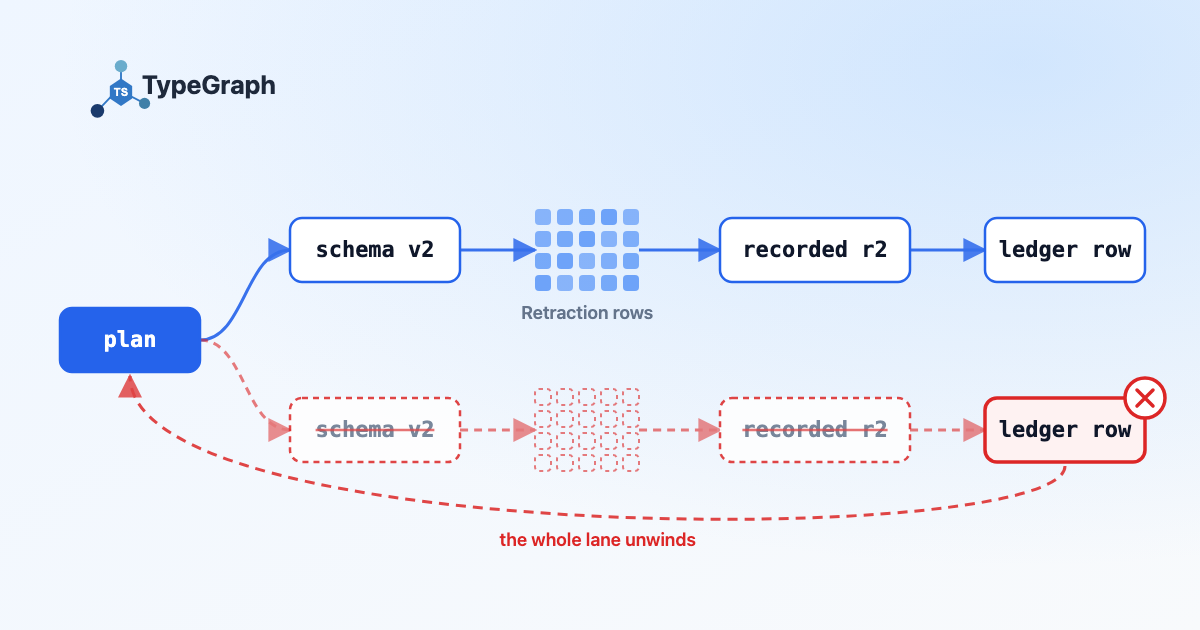
Runtime Schema Evolution ended with an agent
adding a kind for retraction notices to a live graph. This post uses a cut-down
version of that: a Retraction kind added to a graph of publications.
store.evolve() commits a change like that in a transaction of its own and
hands back a new Store. That’s fine when the schema change is the whole job,
but not when your service keeps its own bookkeeping next to the graph, say a
schema_audit table recording which schema version each import ran under.
If you do it in the obvious order, evolve() commits first, then a second
transaction writes the retraction row and the audit row. When something
downstream throws in that second transaction, this is what’s left:
evolve(), then a failed import: active schema version 2 schema_audit rows 0 Retraction node rows 0The schema is at version 2 but nothing else moved, so there’s a Retraction
kind that no ledger entry mentions and no row uses. Nothing is corrupt, but
your bookkeeping and the database now disagree about which schema exists,
because the schema change was the one step that couldn’t join the transaction.
As of 0.62 it can join, and the rest of this post shows how.
Plan outside, apply inside
Section titled “Plan outside, apply inside”The setup is a graph with one kind, the extension the agent proposed, and a Drizzle table for the audit ledger in the same database.
const Publication = defineNode("Publication", {  schema: z.object({ doi: z.string(), title: z.string() }),});
const graph = defineGraph({  id: "trials",  nodes: { Publication: { type: Publication } },  edges: {},});
const retractions = defineGraphExtension({  nodes: {    Retraction: {      properties: {        doi: { type: "string", minLength: 1 },        reason: { type: "string" },      },    },  },});
const schemaAudit = sqliteTable("schema_audit", {  id: integer("id").primaryKey({ autoIncrement: true }),  schemaVersion: integer("schema_version").notNull(),  recordedAt: text("recorded_at"),});
The change is split into planning and applying. planEvolution() runs before
any transaction opens, validates the extension against the active schema
without writing anything, and returns an immutable plan that names the schema
it starts from and the one it produces:
const plan = await store.planEvolution(retractions);{ "status": "change", "graphId": "trials", "baseline": { "version": 1, "hash": "89654f9e5c1debfb" }, "result": { "version": 2, "hash": "aec6b8d50bf21bf8" }, "requirements": [ { "kind": "new-kind", "entity": "node", "kindName": "Retraction" } ]}Doing the planning outside means the slow, fallible part (validation, diffing) never holds a lock. For ordinary additions like a new kind or an optional scalar field, applying the plan needs no entity scans and no DDL.
Applying takes your transaction. better-sqlite3 is synchronous, so Drizzle’s
db.transaction() can’t take an async callback, and a small helper drives
BEGIN/COMMIT/ROLLBACK on the one connection. With node-postgres or libSQL
you’d pass the nativeTx from db.transaction(async (nativeTx) => …) instead;
the cross-store transactions recipe
covers both.
async function inTransaction<T>( db: BetterSQLite3Database, run: () => Promise<T>,): Promise<T> { db.run(sql`BEGIN`); try { const result = await run(); db.run(sql`COMMIT`); return result; } catch (error) { db.run(sql`ROLLBACK`); throw error; }}const outcome = await inTransaction(db, async () => { const applied = await store.withEvolvedTransaction(db, plan, async (tx) => { const notices = tx.getNodeCollection("Retraction"); if (notices === undefined) throw new Error("Retraction kind missing"); await notices.create({ doi: "10.1/a", reason: "fabricated" }); });
db.insert(schemaAudit) .values({ schemaVersion: applied.receipt.schema.version, recordedAt: String(applied.receipt.recorded), }) .run(); return applied;});
const current = await store.refreshSchema({ minVersion: outcome.receipt.schema.version,});Inside the callback, tx already sees the new schema: Retraction is
writable even though the committed schema doesn’t have it yet. The receipt
carries the exact schema version and hash the transaction produced (and, on a
history-enabled store, the recorded-time anchor), so the audit row stores what
the import actually ran under instead of what the code assumed. Treat the
receipt as provisional until your outer COMMIT succeeds; after that,
refreshSchema() hands the new schema to the Store you keep around.
To check the rollback, I threw an error after the ledger insert and ran the same plan twice, once failing and once clean:
attempt 1 (fails after the callback): receipt: schema v2, recorded r1:0000000000000002:2026-09-20T19:12:56.201Zafter rollback: active schema version 1 schema_audit rows 0 Retraction node rows 0attempt 2 (same plan): receipt: schema v2, recorded r1:0000000000000002:2026-09-20T19:12:56.202Zafter commit: active schema version 2 schema_audit rows 1 Retraction node rows 1The failed attempt got as far as a receipt and a ledger row visible inside the
transaction, and none of it survived; when I checked the recorded-history table
directly it had no Retraction rows either. The retry reused the same plan, got
the same recorded revision, and committed, so the schema, the rows, the
history, and your own table commit or roll back together.
If another writer evolves the graph between planning and applying, the apply
throws StaleVersionError and the transaction is yours to roll back and
replan.
No-ops, and schema-only checkpoints
Section titled “No-ops, and schema-only checkpoints”A pipeline that runs the same wiring on every deploy will mostly produce no-op
plans. Plan an extension the Store already has and you get
status: "noop", which doesn’t need the exclusive schema lock, so an ordinary
withRecordedTransaction() is enough:
const again = await current.planEvolution(retractions);if (again.status === "noop") { await inTransaction(db, () => current.withRecordedTransaction(db, async (tx) => { const notices = tx.getNodeCollection("Retraction"); if (notices === undefined) throw new Error("Retraction kind missing"); await notices.create({ doi: "10.1/b", reason: "duplicate publication" }); }), );}The opposite case is a schema change that is itself the event worth recording.
On a history-enabled store, tx.requestRecordedRevision() puts the change on
the recorded timeline even when no entities change: the receipt reports zero
writes, schema version 2, and a recorded anchor.
Merges and reviewed writes that bring their own kinds
Section titled “Merges and reviewed writes that bring their own kinds”0.61 added applyMergePlanInTransaction() for applying an approved merge plan
next to your own SQL. But a merge plan is built against a specific schema, so a
merge that introduces a kind the target doesn’t have yet couldn’t share a
commit with the evolution that adds it. 0.62 closes that gap:
branchForEvolution() forks a branch that already has the planned kinds, and
planMergeForEvolution() plans against the resulting schema.
const evolutionPlan = await target.planEvolution(retractions);const futureBranch = unwrap(  await branchForEvolution(target, evolutionPlan, makeIsolatedBackend),);try {  await futureBranch.store    .getNodeCollectionOrThrow("Retraction")    .create({ doi: "10.1/a", reason: "fabricated" });
  const mergePlan = unwrap(    await planMergeForEvolution(target, evolutionPlan, [futureBranch]),  );
  await inTransaction(db, () =>    target.withEvolvedTransaction(db, evolutionPlan, (tx) =>      applyMergePlanInTransaction(target, tx, mergePlan),    ),  );} finally {  await futureBranch.close();}
A plan built the ordinary way, against the old schema, is rejected inside the
evolved transaction with MergePlanSchemaMismatchError before anything is
written.
0.65 does the same for candidate write sets, the branch-free way to propose
changes as a JSON document a reviewer can read.
planCandidateWriteSetForEvolution() plans the agent’s proposed Retraction
records against the schema the pending evolution will produce, and nothing is
written until the reviewed plan is applied inside withEvolvedTransaction().
Because review takes time and the target can move in the meantime, there are
two different stale outcomes. If a write lands while the plan is being built,
planning returns a MergePlanningStaleError, and you recapture the target and
replan. If the target changes after you already hold a finished plan, applying
throws StaleMergePlanError inside the outer transaction, and the schema
change rolls back with it. I injected a write after planning to check this, and
the active schema was still at version 1 afterwards.
Limits
Section titled “Limits”- Plans stay in one process. A plan is an in-memory token that can’t be serialized or reconstructed, so plan and apply in the same process.
- The default adapter only does DML. A plan that needs new storage (a
vector slot, identity work) is rejected before the callback runs, unless you
use a privileged adapter configured with
schemaProvisioning: "transactional". Indexes stay outside too: callmaterializeIndexes()after commit. - Only your database’s writes are atomic. The ledger row is atomic with the schema change because they share a connection. A message you publish to a queue from inside the callback is not.
- Driver support varies. SQLite adoption needs a native connection with an observable transaction state (better-sqlite3 has one); HTTP-only drivers can’t adopt schema transactions at all.
Custom StoreEvolution implementations need planEvolution() and
refreshSchema(), and custom adapters must now declare schemaProvisioning
explicitly.
Try it
Section titled “Try it”- Plan outside and apply inside a caller-owned transaction
- Merge after schema evolution in one caller transaction and candidate write sets for a planned schema
- Adopted schema transactions: per-driver requirements
- GitHub
Stay in the loop
Occasional updates on new features, guides, and releases. No spam.